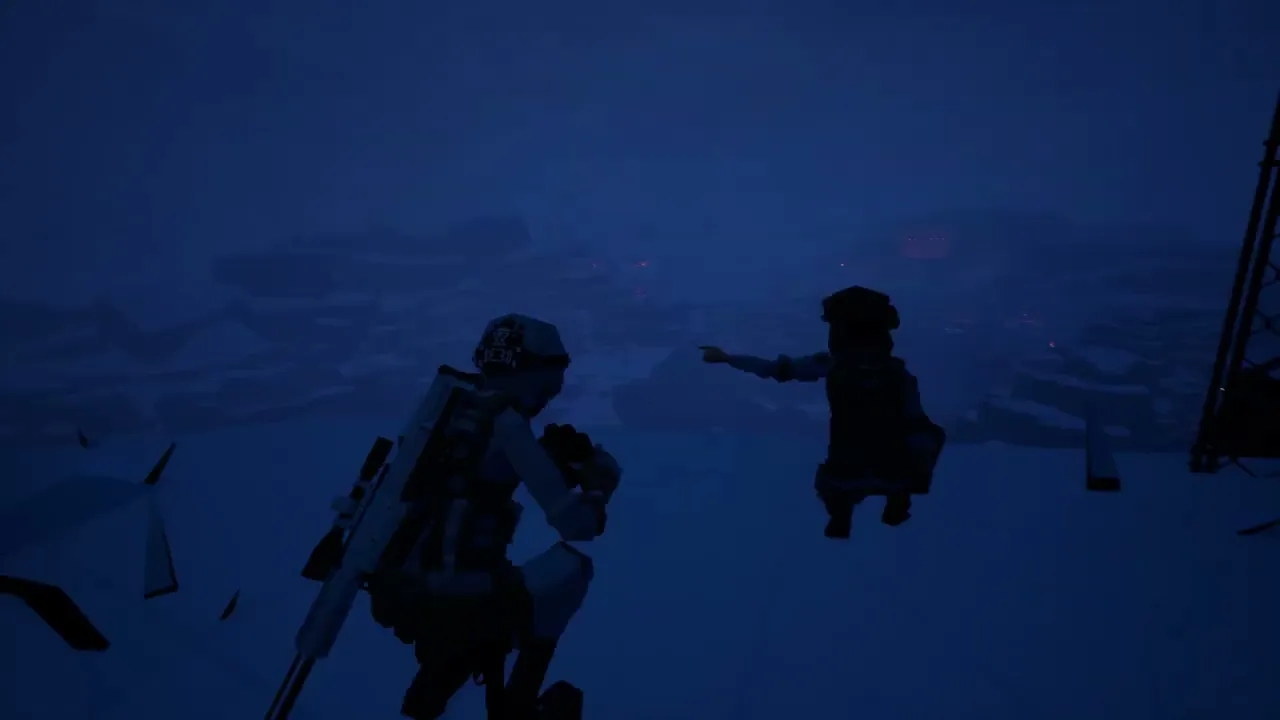
OPERATION: BIRD STRIKE
Summary:
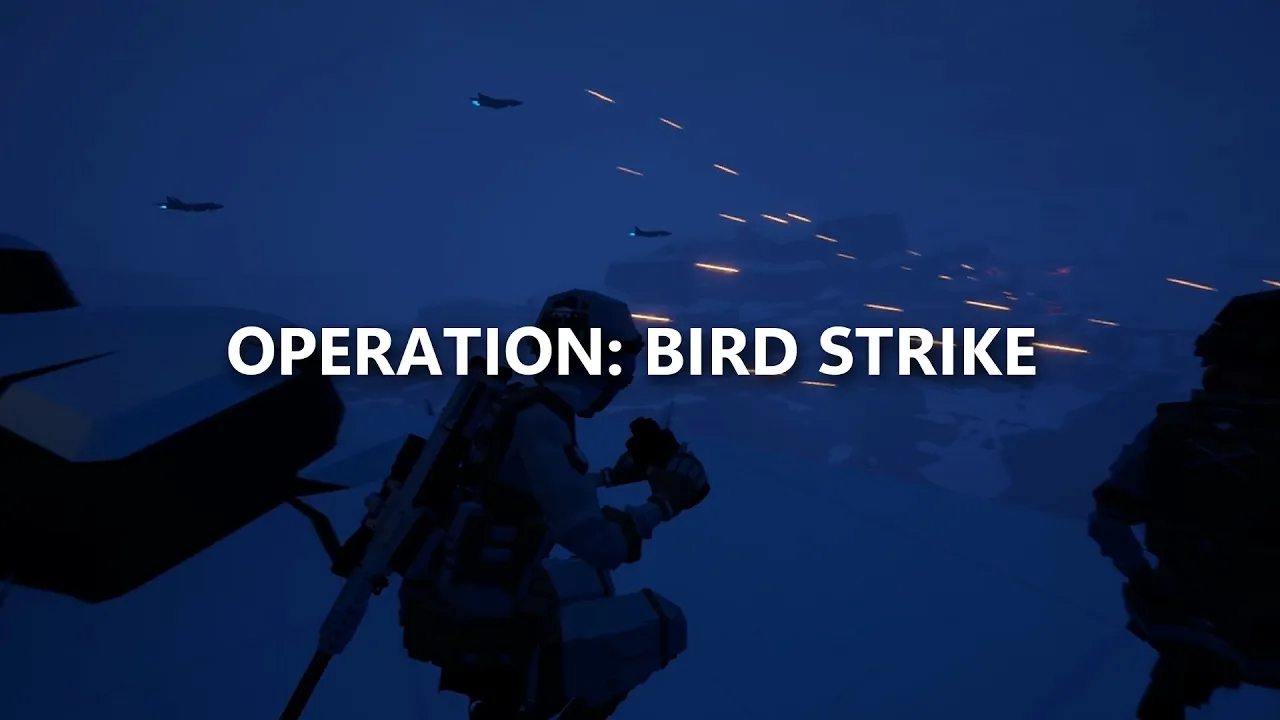
The enemy is building a superweapon inside a massive bunker. When an allied attack goes sideways, you get tasked to sneak in, rig the Anti-air guns with C4, and take them out. Once the skies are clear of hostile missiles, allied forces will swoop in and finish the job; Blowing up the bunker and ending the war once and for all.
Goals:
Driving Tension and Act Structure
Making dynamic Stealth Combat
Creating a Cinematic Experience
Focusing on Narrative & Story
Project Breakdown:
Solo 7 weeks halftime (4hours/day)
Created using Unreal Engine 5.6 and the AGLS template by Jakub W
Marketplace Assets Used:
Character Models by UNDERKING
Helicopter model by Max3d
Blockout Assets by Xavier Loux
Nature Models by Vertex Rage Studio
Tank model by ithappy
Power Lines by Chase W. via Poly Pizza
Washing Machine by Alex Safayan via Poly Pizza
Sky & Weather by Everett Gunther
Additional animations from Mixamo
Trailer:
Overview:
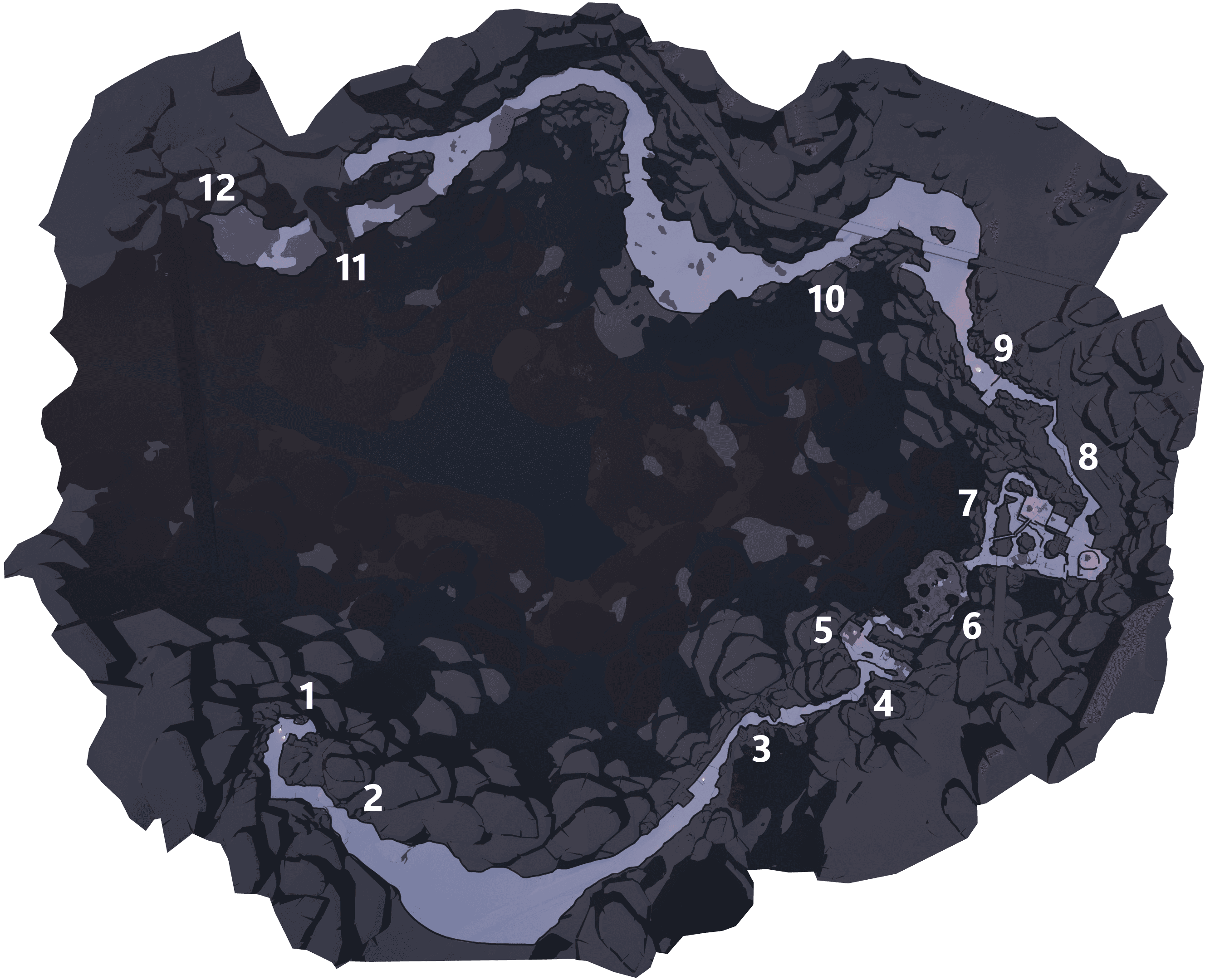
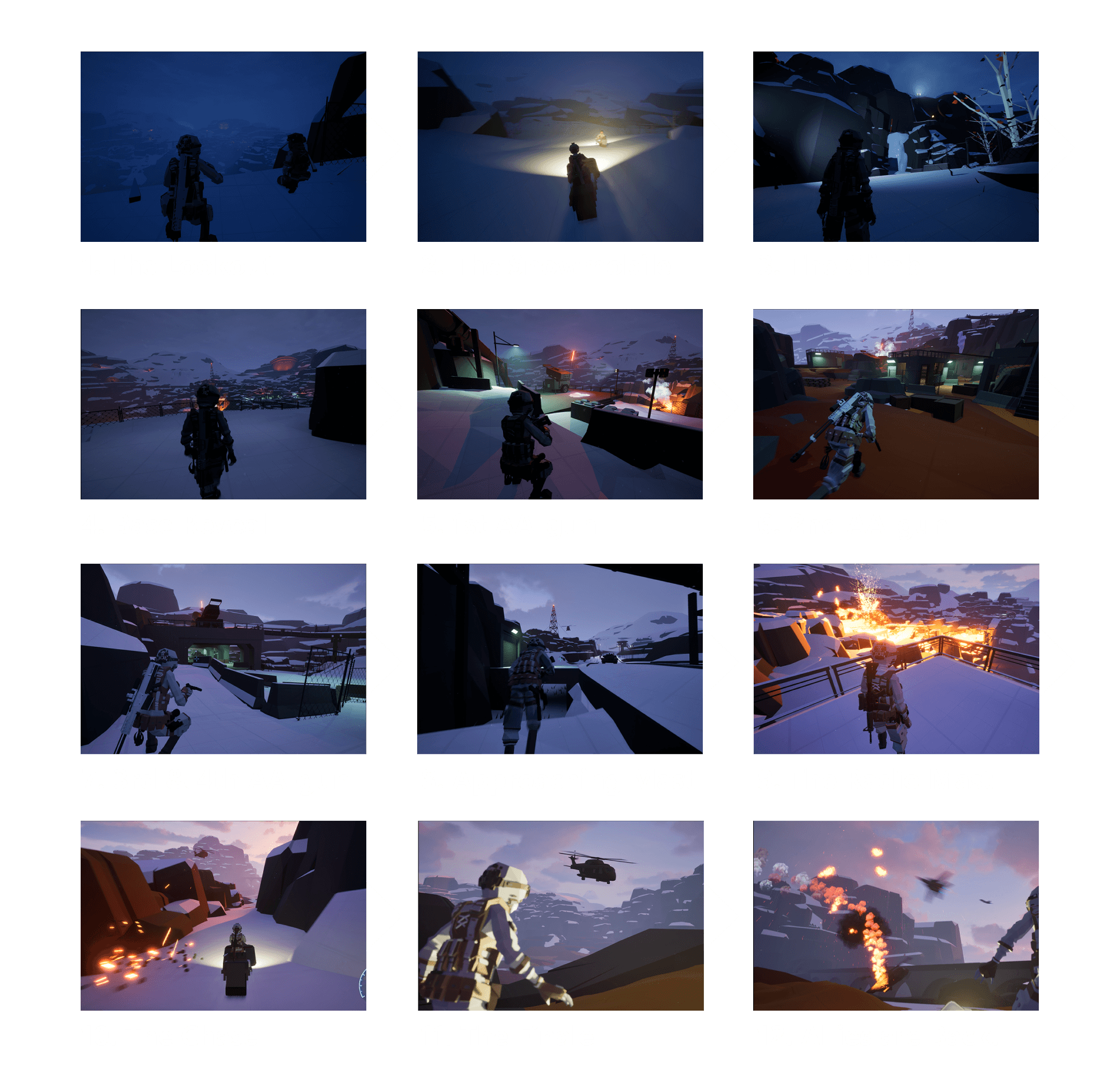
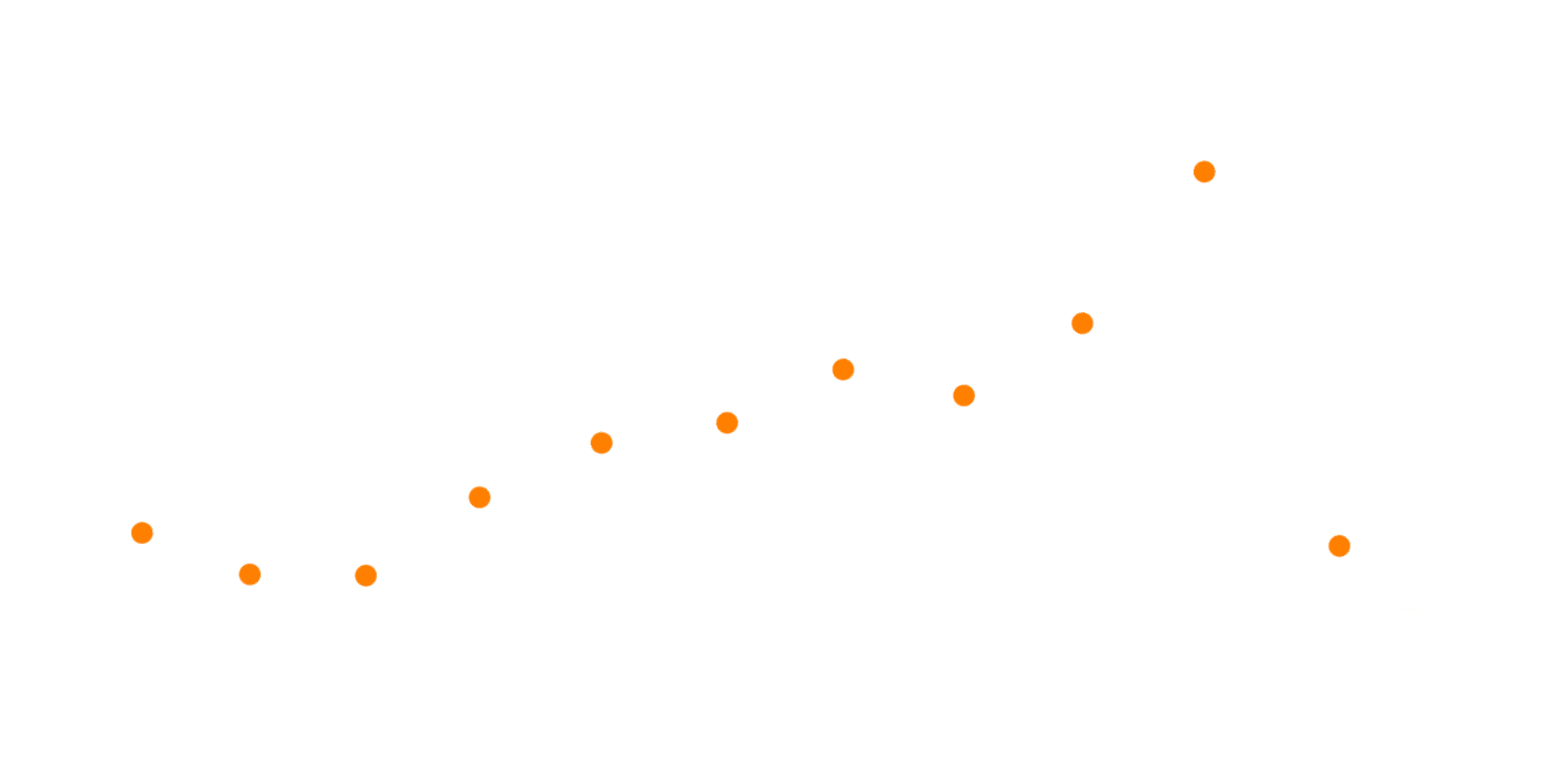
Tension Graph:
Level Breakdown:
The Lookout & First Attack:
I open the level in medias res, placing the player in motion alongside their companion to create immediate urgency. At the top of the slope, an establishing shot reveals the enemy base, bunker, AA-guns, and radio mast. This transitions into a clear cause-and-effect moment as allied jets approach, the AA-guns fire, and one aircraft is shot down. By showing the threat and its consequence, I communicate the problem organically and direct the player towards disabling the defenses. The player’s objective is further explained by their companion.
I open the level in medias res, placing the player in motion alongside their companion to create immediate urgency. At the top of the slope, an establishing shot reveals the enemy base, bunker, AA-guns, and radio mast. This transitions into a clear cause-and-effect moment as allied jets approach, the AA-guns fire, and one aircraft is shot down. By showing the threat and its consequence, I communicate the problem organically and direct the player towards disabling the defenses. The player’s objective is further explained by their companion.
The Snowmobile:
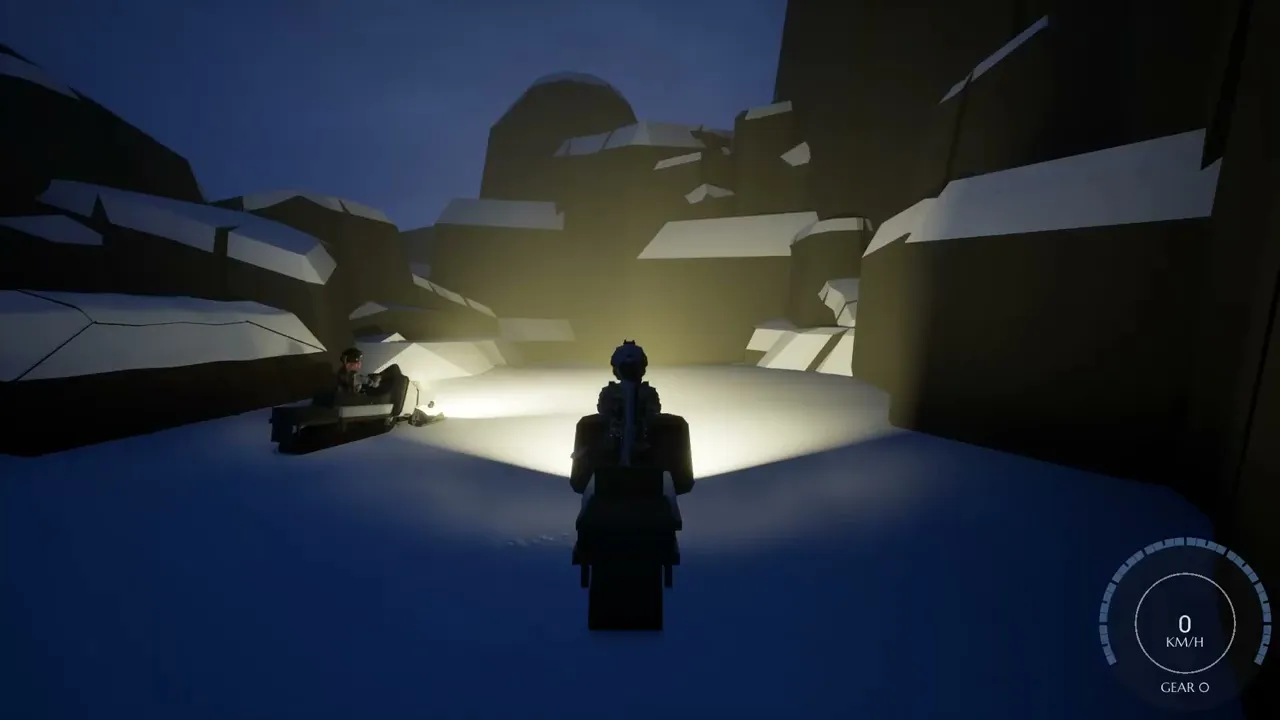
The descent introduces the snowmobile as a new traversal mechanic, giving the player a brief but engaging taste of high-speed movement. As the player rides down the mountainside, their companion splits off toward a parallel objective and joins them on the comms. I intentionally restrict the player by cutting the path short when another mountain stands in the way of the base, forcing the player to continue on foot and deliberately limiting their time with the vehicle. I establish the snowmobile as something valuable and exciting, and by introducing it early in a controlled way, I ensure that the player recognizes it in the final act, where its return should feel both natural and rewarding.
The descent introduces the snowmobile as a new traversal mechanic, giving the player a brief but engaging taste of high-speed movement. As the player rides down the mountainside, their companion splits off toward a parallel objective and joins them on the comms. I intentionally restrict the player by cutting the path short when another mountain stands in the way of the base, forcing the player to continue on foot and deliberately limiting their time with the vehicle. I establish the snowmobile as something valuable and exciting, and by introducing it early in a controlled way, I ensure that the player recognizes it in the final act, where its return should feel both natural and rewarding.
The Climb:
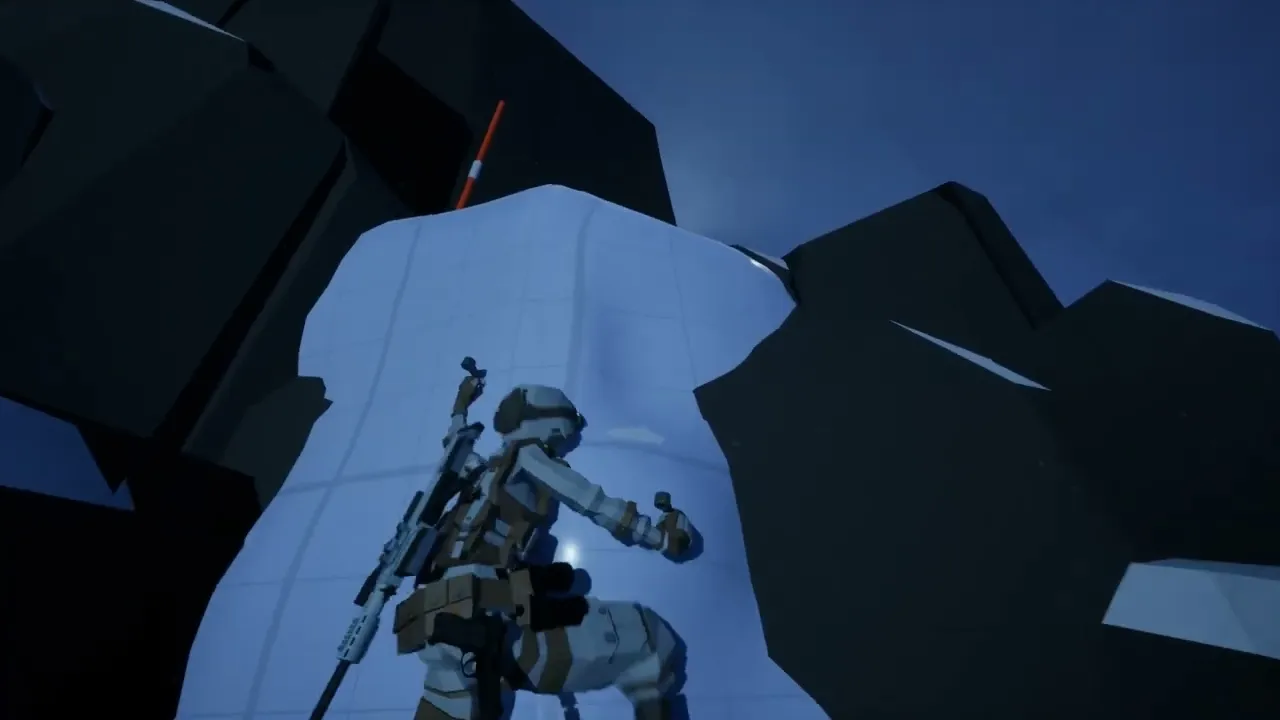
The radio mast and bunker are framed between peaks of the mountain, helping establish orientation and build a clear mental map. As the player ascends, these landmarks disappear from view, creating tension while still guiding movement in the correct direction. A rusted pipe lined with red lights leads the way upward, visually connecting to similar lighting around key objectives and reinforcing that the player is on the right path. The pacing slows in this section and I added an abandoned enemy camp to create unease and anticipation. At the summit, I funnel the player before revealing a wide vista, to heighten the impact of the enemy base reveal and reward the long climb.
The radio mast and bunker are framed between peaks of the mountain, helping establish orientation and build a clear mental map. As the player ascends, these landmarks disappear from view, creating tension while still guiding movement in the correct direction. A rusted pipe lined with red lights leads the way upward, visually connecting to similar lighting around key objectives and reinforcing that the player is on the right path. The pacing slows in this section and I added an abandoned enemy camp to create unease and anticipation. At the summit, I funnel the player before revealing a wide vista, to heighten the impact of the enemy base reveal and reward the long climb.
Base Reveal:
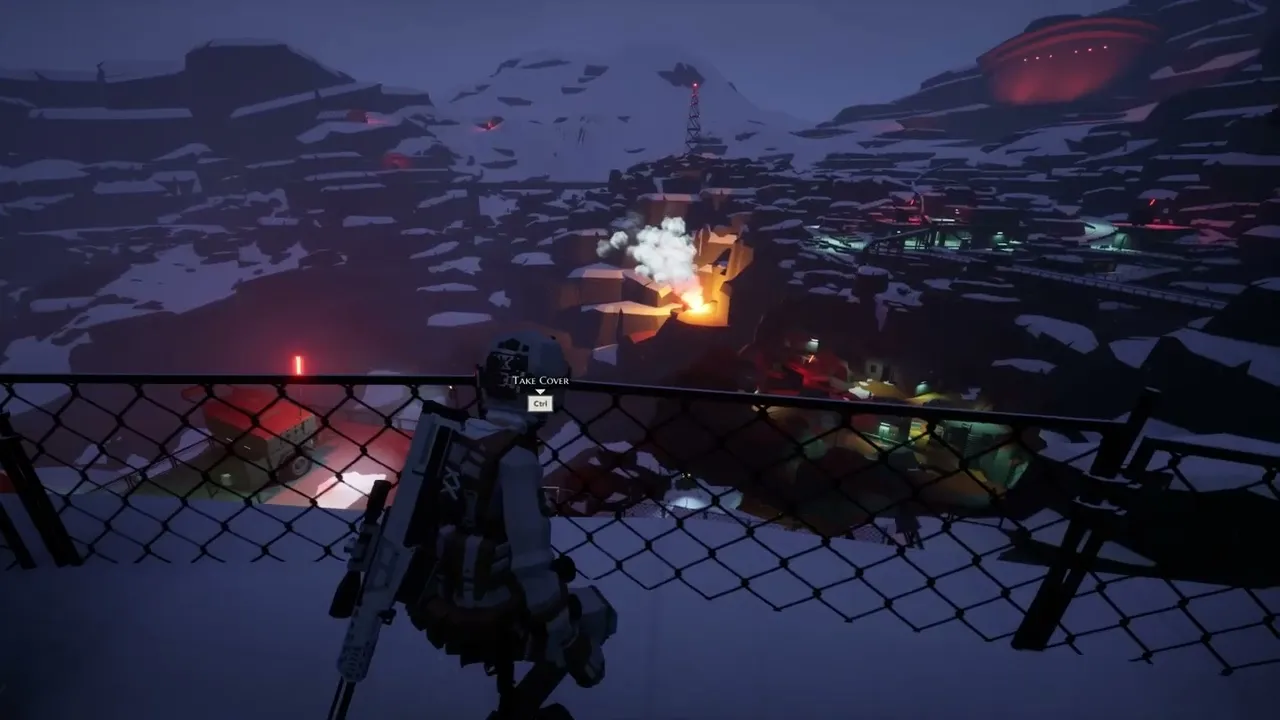
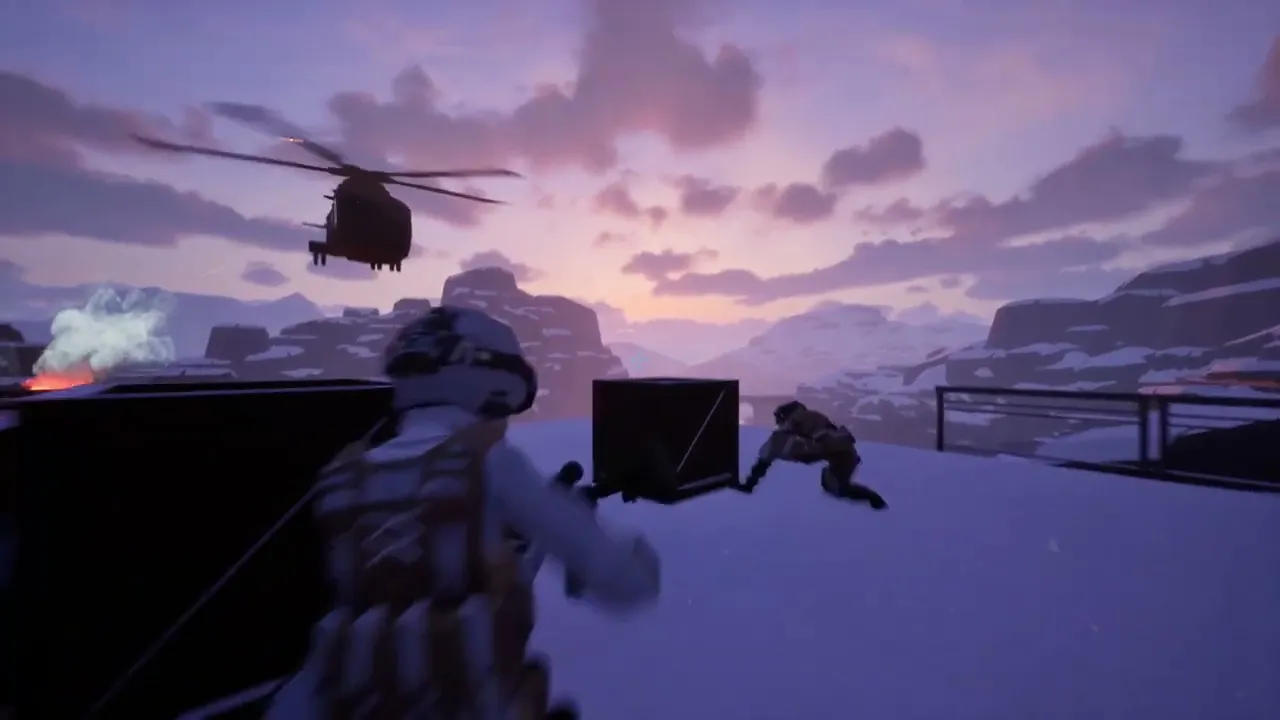
The vista overlooks the enemy base, clearly revealing the AA-guns, bunker, and radio mast from a safe vantage point. This moment allows the player to study the layout and re-establish the radio mast as the rendezvous point. An enemy helicopter flies through the scene, naturally drawing attention to the AA-guns as it moves before disappearing behind a mountain peak. This encounter with the helicopter also acts as foreshadowing, setting up its later role in the final act.
The vista overlooks the enemy base, clearly revealing the AA-guns, bunker, and radio mast from a safe vantage point. This moment allows the player to study the layout and re-establish the radio mast as the rendezvous point. An enemy helicopter flies through the scene, naturally drawing attention to the AA-guns as it moves before disappearing behind a mountain peak. This encounter with the helicopter also acts as foreshadowing, setting up its later role in the final act.
First AA-gun:
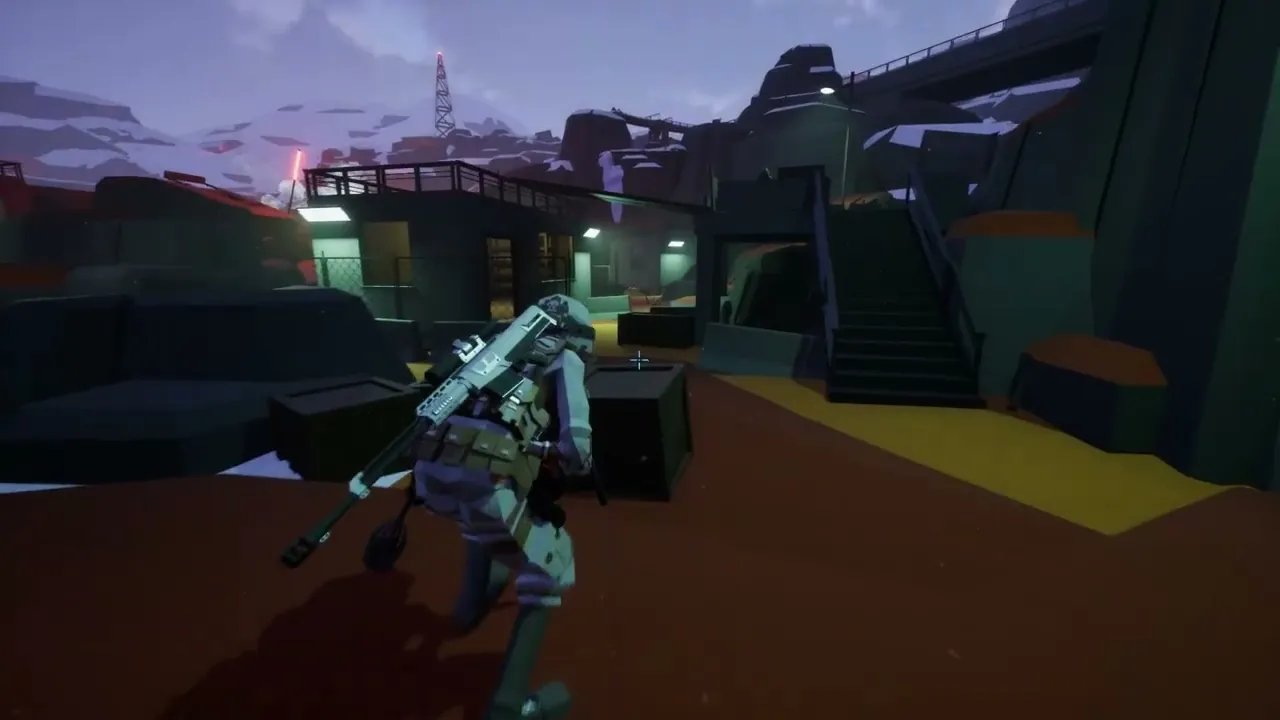
In the first AA-gun area, the player slides down a slope into the encounter and is briefly exposed before reaching the safety of cover, creating a small moment of tension. After clearing the area, the player plants their first C4 charge. Entering the next area, a one-way valve prevents backtracking and helps maintain a clear mental map.
In the first AA-gun area, the player slides down a slope into the encounter and is briefly exposed before reaching the safety of cover, creating a small moment of tension. After clearing the area, the player plants their first C4 charge. Entering the next area, a one-way valve prevents backtracking and helps maintain a clear mental map.
Second AA-gun:
The Lookout & First Attack:
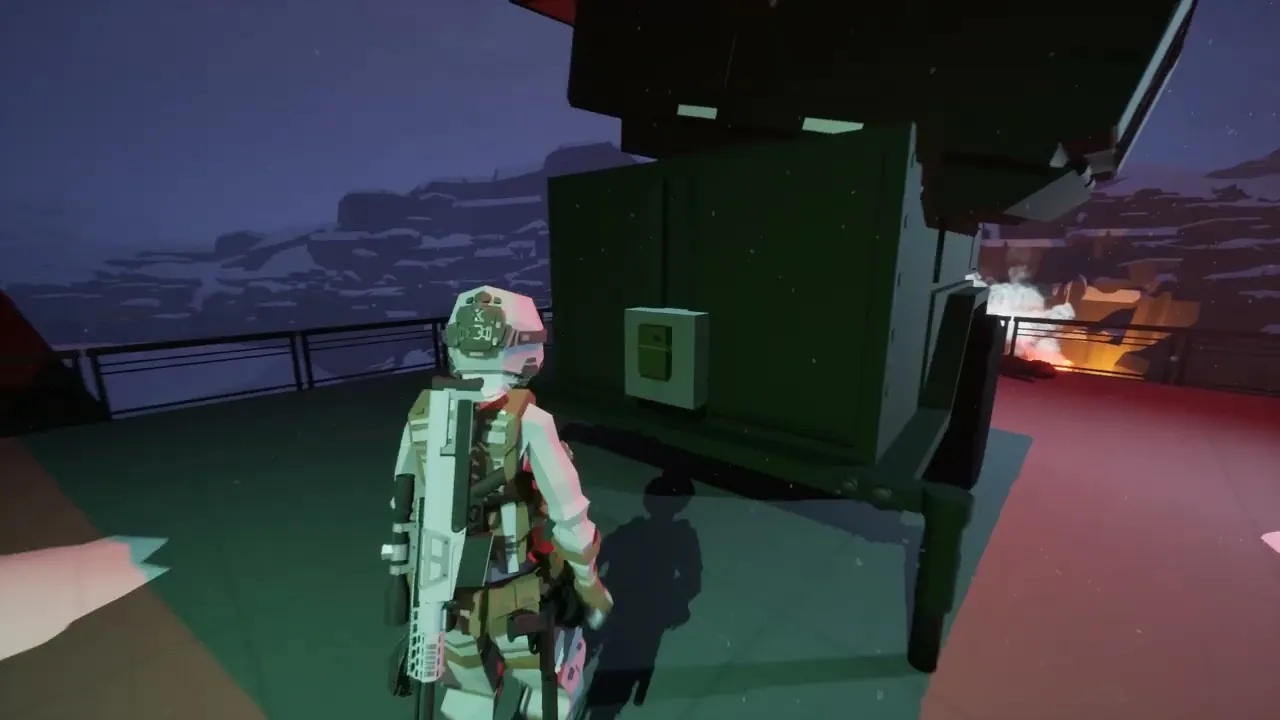
The second area expands on player choice, offering more enemies and multiple paths. I iterated on cover placement to support different approaches to the objective and encourage experimentation. After planting the C4, the player ascends toward the next area where a tank is introduced as a new threat, briefly appearing and disappearing behind a rock before re-emerging as the player reaches the next space, increasing tension and anticipation.
The second area expands on player choice, offering more enemies and multiple paths. I iterated on cover placement to support different approaches to the objective and encourage experimentation. After planting the C4, the player ascends toward the next area where a tank is introduced as a new threat, briefly appearing and disappearing behind a rock before re-emerging as the player reaches the next space, increasing tension and anticipation.
I open the level in medias res, placing the player in motion alongside their companion to create immediate urgency. At the top of the slope, an establishing shot reveals the enemy base, bunker, AA-guns, and radio mast. This transitions into a clear cause-and-effect moment as allied jets approach, the AA-guns fire, and one aircraft is shot down. By showing the threat and its consequence, I communicate the problem organically and direct the player towards disabling the defenses. The player’s objective is further explained by their companion.
Third & Fourth AA-gun:
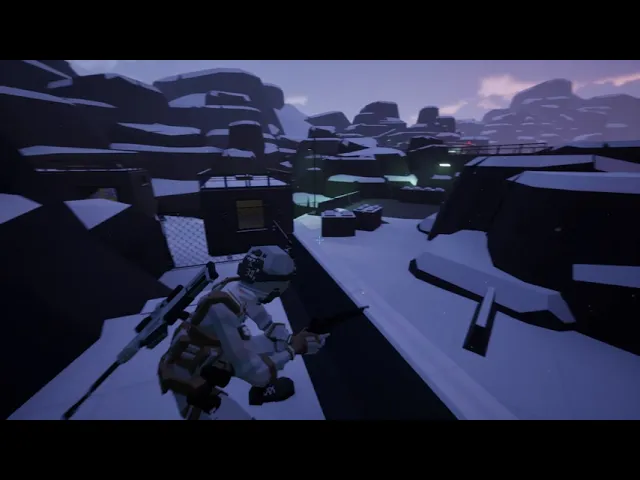
In the third area, the tank remains an active presence, adding more pressure to the encounter. The player is tasked with planting C4 on two AA-guns. Increased enemy density and varied traversal options further reinforce player agency while maintaining a heightened sense of danger.
In the third area, the tank remains an active presence, adding more pressure to the encounter. The player is tasked with planting C4 on two AA-guns. Increased enemy density and varied traversal options further reinforce player agency while maintaining a heightened sense of danger.
Approaching the Radio Mast:
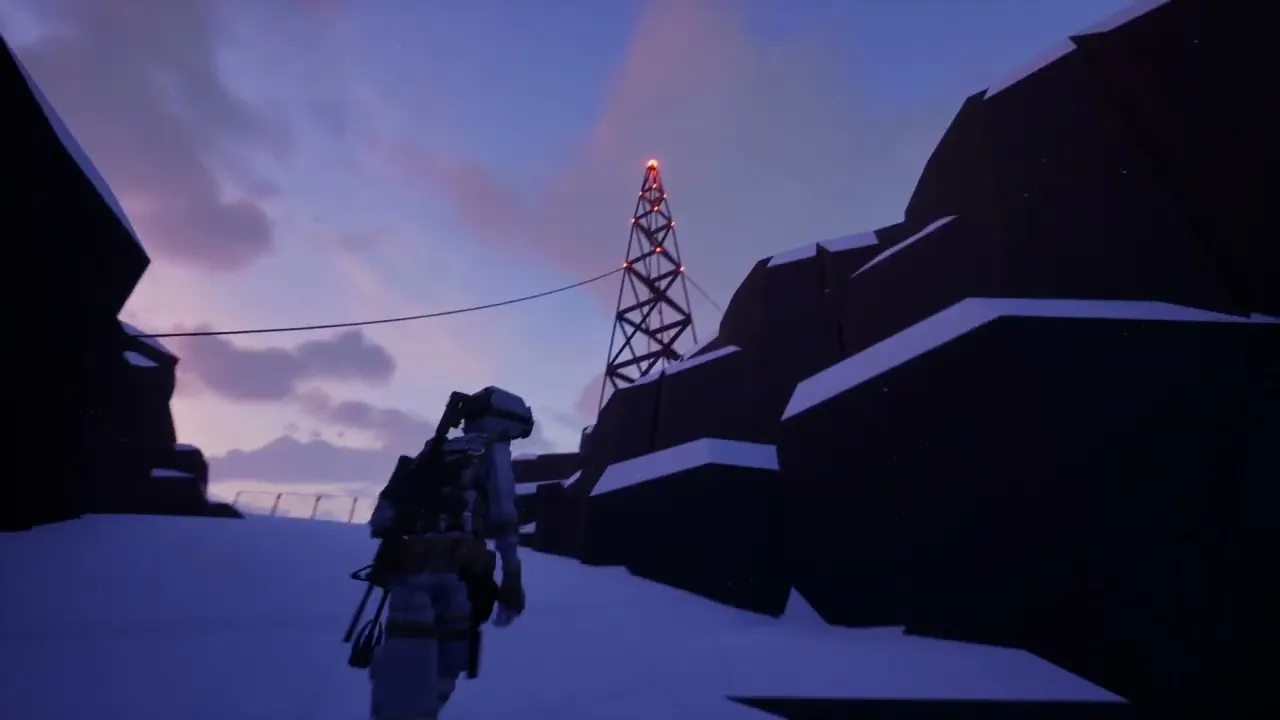
As the player exits, they must stealth past the tank while the helicopter reappears, guiding their attention toward the radio mast. This is followed by a sudden scare of the tank from an unexpected angle, reinforcing its threat. The player hides and continues forward, evading the helicopter by taking cover beneath a bridge. I use this part as another one-way valve which closes off previous areas, keeping focus ahead. The section ends with a tense stealth approach toward the radio mast, as the player navigates past both the tank and enemy soldiers.
As the player exits, they must stealth past the tank while the helicopter reappears, guiding their attention toward the radio mast. This is followed by a sudden scare of the tank from an unexpected angle, reinforcing its threat. The player hides and continues forward, evading the helicopter by taking cover beneath a bridge. I use this part as another one-way valve which closes off previous areas, keeping focus ahead. The section ends with a tense stealth approach toward the radio mast, as the player navigates past both the tank and enemy soldiers.
The Radio Mast:
Upon reaching the radio mast, the perceived endpoint of the level, the player reunites with their companion and triggers the destruction of the AA-guns. The companion initiates the sequence with confident, almost cocky body language, reinforcing a shared sense of power and encouraging the player to feel equally impactful. This moment also provides a brief sense of safety, provided by the companion’s presence. That feeling is quickly disrupted as the helicopter returns, fulfilling its earlier foreshadowing and firing Chekov’s Gun. The companion directs the player toward a distant bridge as a new objective, but is killed in a shootout, shifting the emotional tone from confidence to urgency and loss.
Upon reaching the radio mast, the perceived endpoint of the level, the player reunites with their companion and triggers the destruction of the AA-guns. The companion initiates the sequence with confident, almost cocky body language, reinforcing a shared sense of power and encouraging the player to feel equally impactful. This moment also provides a brief sense of safety, provided by the companion’s presence. That feeling is quickly disrupted as the helicopter returns, fulfilling its earlier foreshadowing and firing Chekov’s Gun. The companion directs the player toward a distant bridge as a new objective, but is killed in a shootout, shifting the emotional tone from confidence to urgency and loss.
The Chase:
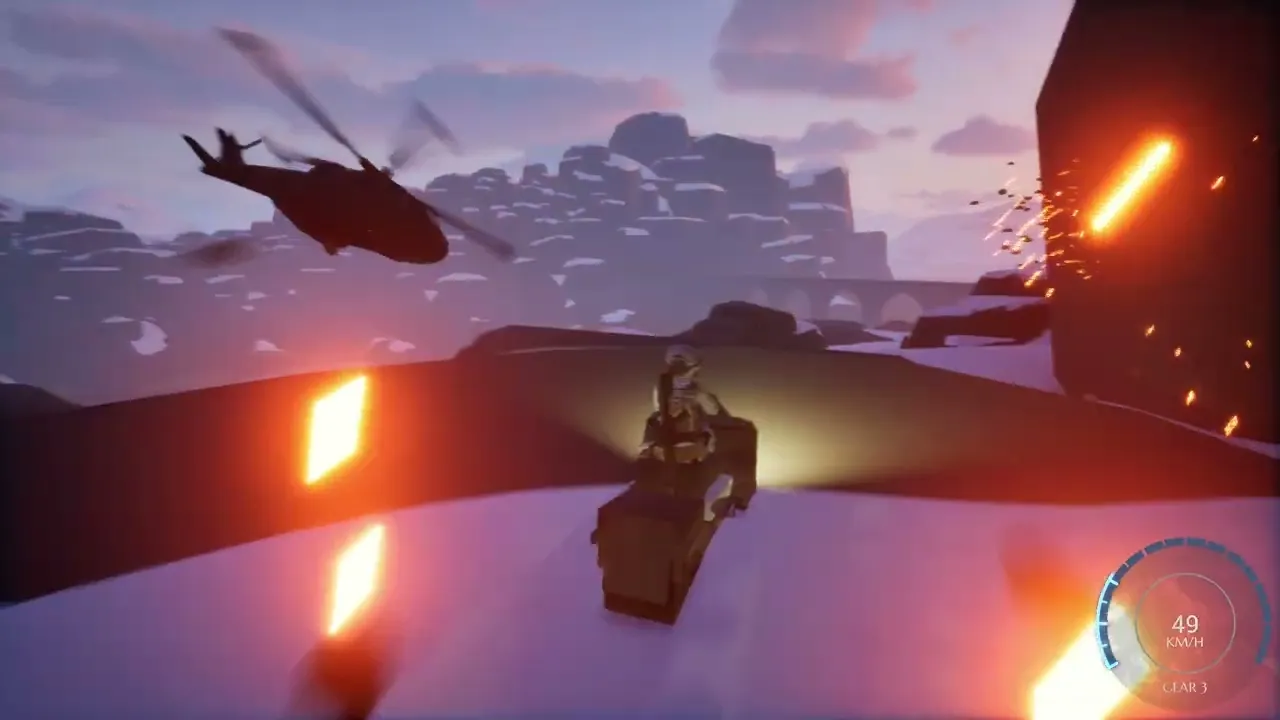
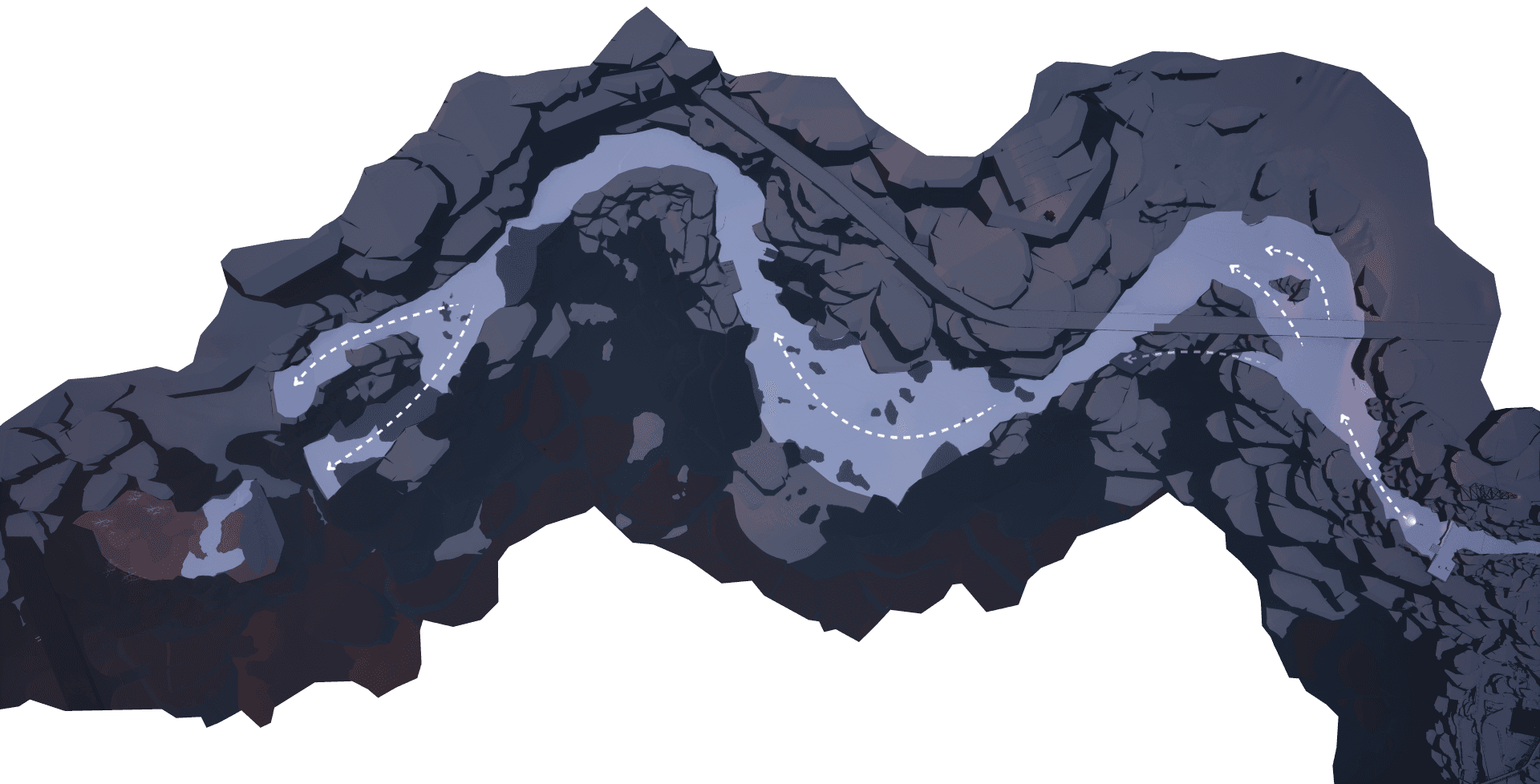
The player is immediately put into a high-intensity escape, jumping onto a snowmobile and racing down the mountain toward the bridge. This sequence pays off the earlier introduction of the vehicle, now fully realized in a fast-paced chase. I made the chase with lots of turns and constant pressure, leaving no room for rest and pushing tension to its peak. Halfway through the escape, the tank reappears and fires at the player, narrowly missing, again maintaining its presence as a persistent threat.
The player is immediately put into a high-intensity escape, jumping onto a snowmobile and racing down the mountain toward the bridge. This sequence pays off the earlier introduction of the vehicle, now fully realized in a fast-paced chase. I made the chase with lots of turns and constant pressure, leaving no room for rest and pushing tension to its peak. Halfway through the escape, the tank reappears and fires at the player, narrowly missing, again maintaining its presence as a persistent threat.
The Finale:
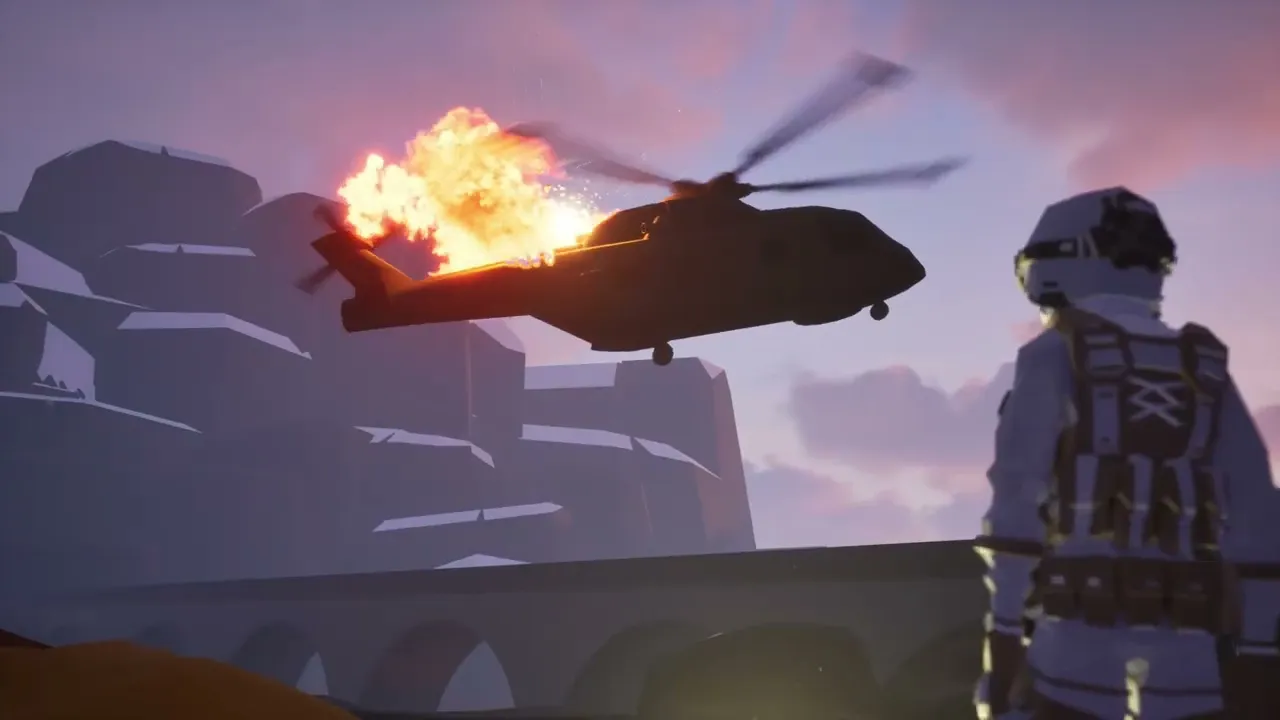
Still pursued by the helicopter, the player launches across a large gap, transitioning into a cutscene where they are thrown from the snowmobile and left injured and vulnerable. With no means to fight back, I’m hoping the player feels helpless as the helicopter closes in. Just before it fires, it is struck by a missile, creating a brief moment of confusion that quickly turns to relief as allied forces are revealed. A second strike destroys the helicopter, and friendly jets sweep into the valley, successfully bombing the bunker. The player regains a sense of safety, with the outcome showing that their earlier actions directly enabled this final victory.
Still pursued by the helicopter, the player launches across a large gap, transitioning into a cutscene where they are thrown from the snowmobile and left injured and vulnerable. With no means to fight back, I’m hoping the player feels helpless as the helicopter closes in. Just before it fires, it is struck by a missile, creating a brief moment of confusion that quickly turns to relief as allied forces are revealed. A second strike destroys the helicopter, and friendly jets sweep into the valley, successfully bombing the bunker. The player regains a sense of safety, with the outcome showing that their earlier actions directly enabled this final victory.
Section Walkthroughs and Stealth Combat:
First AA-gun:
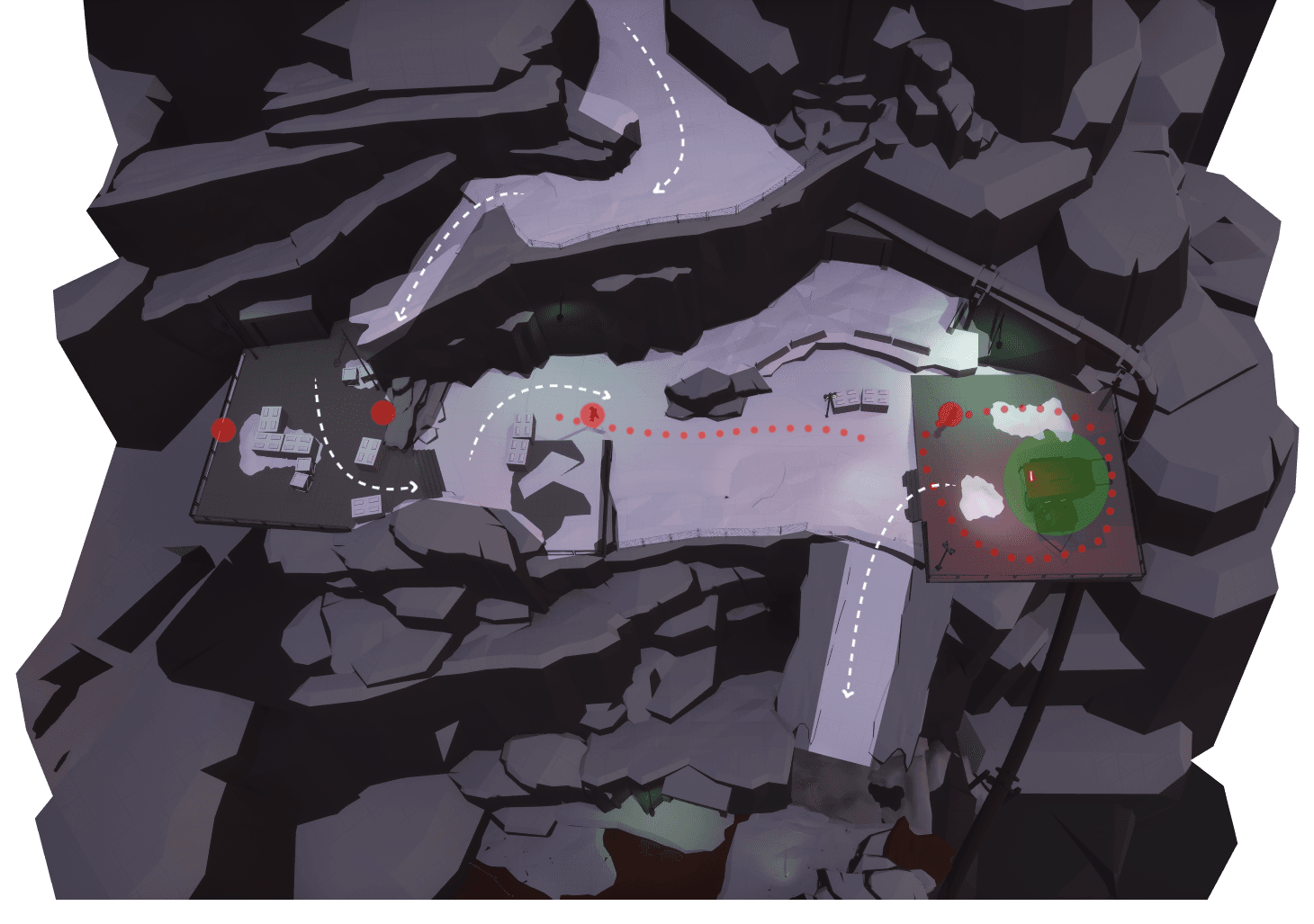
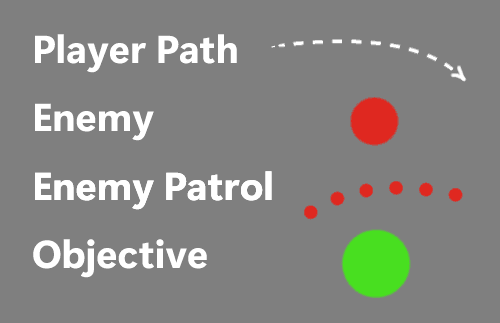
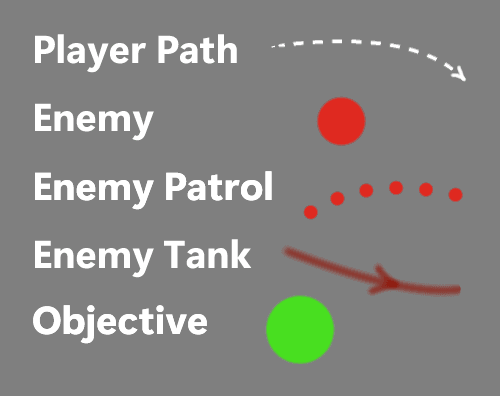
The player enters the first stealth encounter from a covered position, giving them an advantage and control over when they feel ready to engage. This area introduces the core mechanics of stealth combat and planting C4 in a low-risk setting. Two nearby stationary enemies encourage the use of the silenced pistol or melee, while a second patrolling pair closer to the objective introduces movement between cover islands when approaching the enemies, and the use of the silenced sniper rifle since these enemies are farther away.
The player enters the first stealth encounter from a covered position, giving them an advantage and control over when they feel ready to engage. This area introduces the core mechanics of stealth combat and planting C4 in a low-risk setting. Two nearby stationary enemies encourage the use of the silenced pistol or melee, while a second patrolling pair closer to the objective introduces movement between cover islands when approaching the enemies, and the use of the silenced sniper rifle since these enemies are farther away.
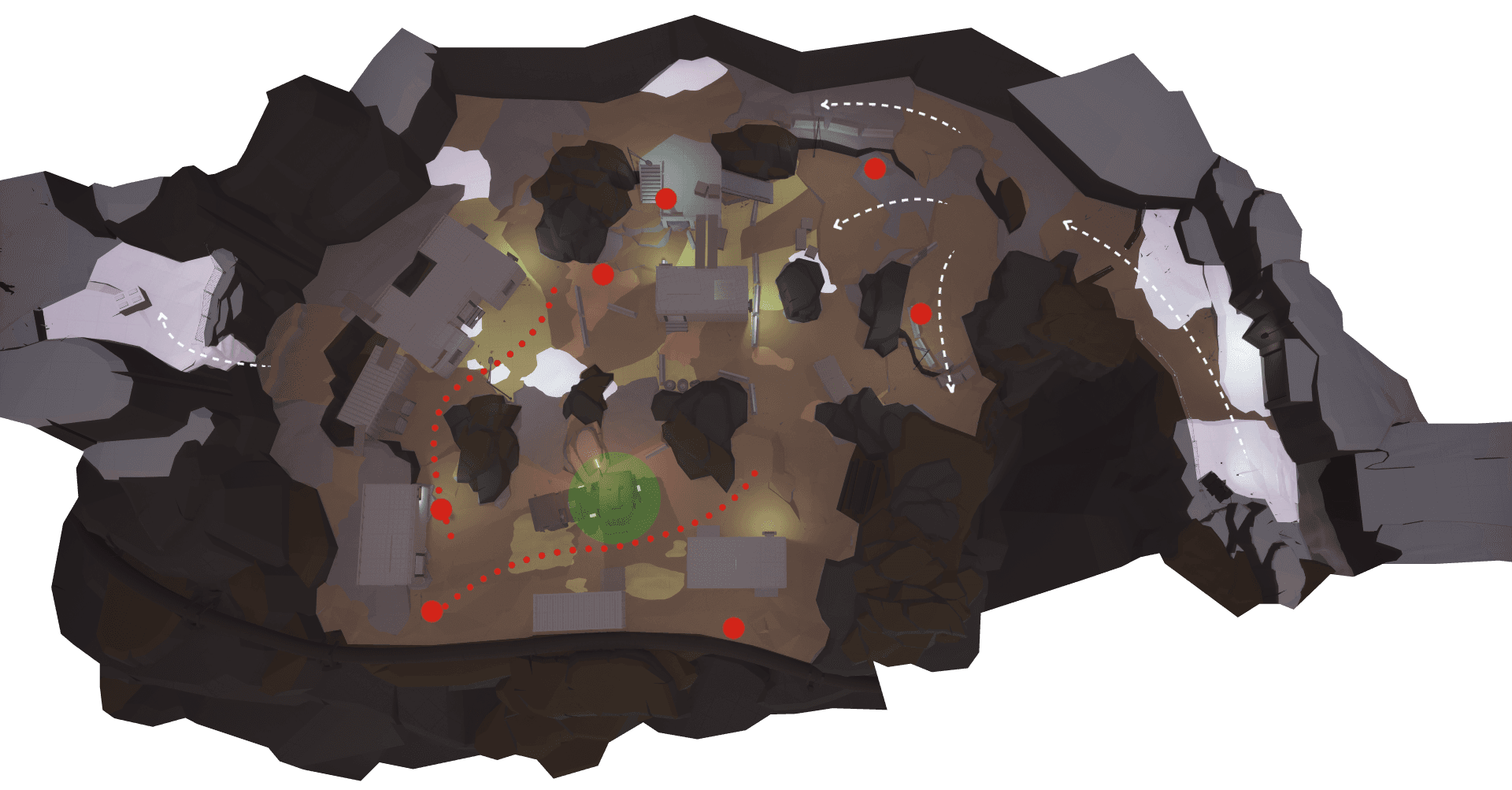
Second AA-gun:
A vantage point allows the player to scout the next area with binoculars before engaging. The space has multiple paths and approaches, offering greater freedom in how to tackle the objective. Increased enemy presence, combined with a mix of patrols and stationed guards, raises the challenge. I use elements like enterable barracks, large rock formations, and smaller half-covers to create opportunities for unique and fun strategies.
A vantage point allows the player to scout the next area with binoculars before engaging. The space has multiple paths and approaches, offering greater freedom in how to tackle the objective. Increased enemy presence, combined with a mix of patrols and stationed guards, raises the challenge. I use elements like enterable barracks, large rock formations, and smaller half-covers to create opportunities for unique and fun strategies.
Third & Fourth AA-gun:
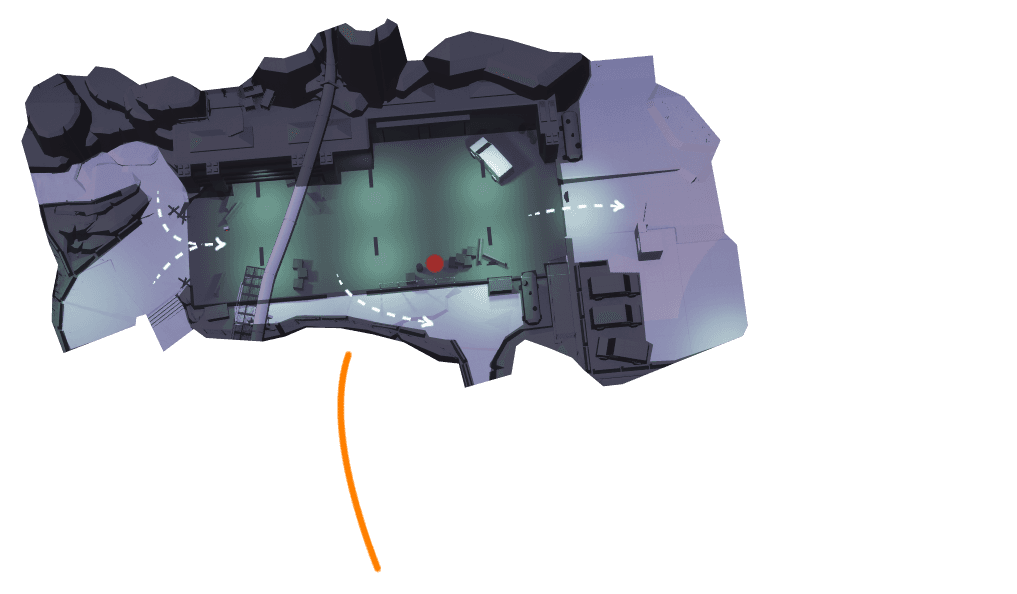
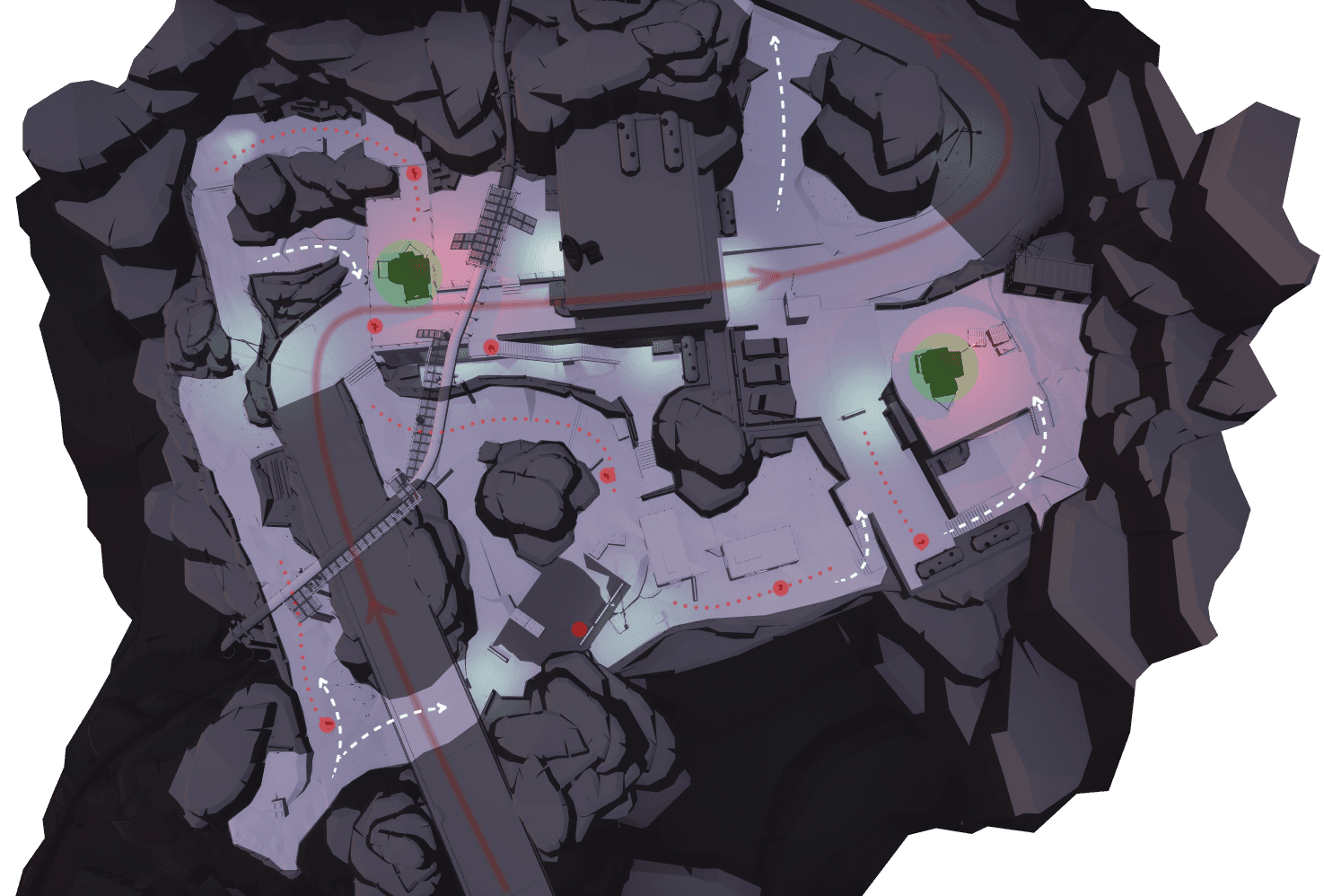
The final two objectives take place within a single, more demanding area that tests the player’s accumulated skills. More stationary and patrolling enemies make navigation trickier, requiring good timing and awareness of most angles. A roaming tank adds pressure to this section, restricting some movement and acting as a natural boundary until both objectives are completed.
The final two objectives take place within a single, more demanding area that tests the player’s accumulated skills. More stationary and patrolling enemies make navigation trickier, requiring good timing and awareness of most angles. A roaming tank adds pressure to this section, restricting some movement and acting as a natural boundary until both objectives are completed.
The Chase:
The path is designed with wide turns and some optional routes, including two risky jumps that make the fast-paced traversal feel dynamic and action packed.
The path is designed with wide turns and some optional routes, including two risky jumps that make the fast-paced traversal feel dynamic and action packed.
Process:
Brainstorming:
When I first started brainstorming ideas for this experience, I set up a few goals for myself. I wanted to make an Action Adventure level and have a main focus on Narrative and Story. I initially wanted the experience to be in First Person as many of my inspirations derived from campaigns of popular titles like Battlefield 4, Call of Duty and Far Cry 4. But eventually settled on Third Person like in the Tomb Raider series, because I felt such a perspective would allow me to really lean into the immersion and action, plus the over-the-shoulder camera allowed me more playroom when it came to cover placement and overall level design, especially in a stealth combat scenario, in comparason to the more narrow eye-centered First Person Perspective.
Setting up the location, I knew I wanted a cold, snowy, environment, and what better place of inspiration for that than in my own home country, Sweden? Which led me to the Arctic tundra region, particularly in the northernmost areas of Lapland.
Regarding combat design, I wanted to learn more about stealth combat and ways of making use of the environment as a playroom for the player, with lots of agency in how one chooses to approach one's objectives, whilst keeping the experience fairly linear in the grander picture.
I also wanted to make good use of Unreal Engine’s sequencer tool to really sell the action and cinematics with explosions and animations.
My ideas boiled down to this; The player sneaks into a snowy mountainous base and plants bombs on enemy Anti-Air guns in order to aid the allied forces. After a sudden twist, the player should need to improvise in order to escape.
Gathering References
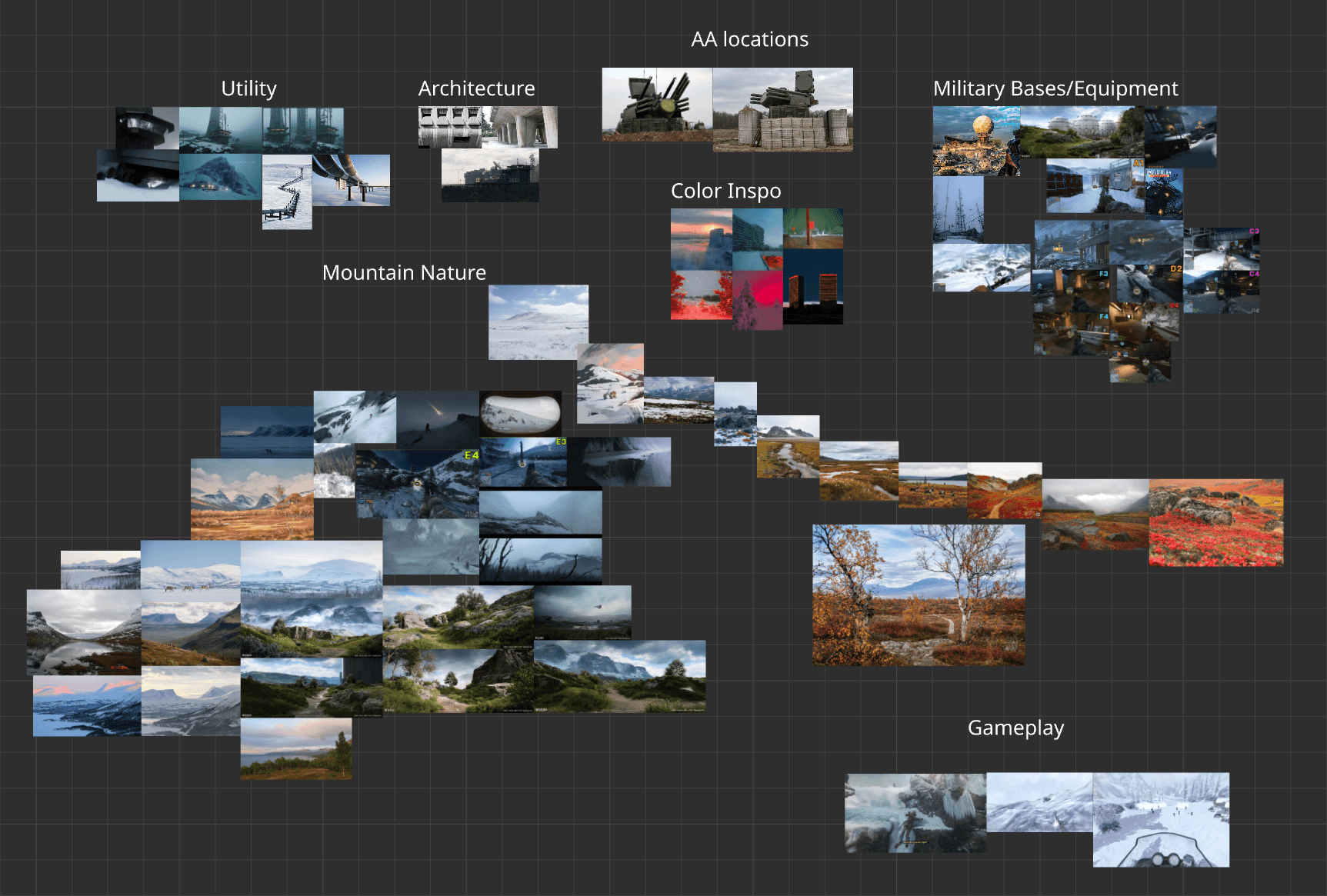
I used a Miro Board as a place for all my reference images and notes so that everything could be stored in the same place. Any location, concept art, architecture, and game inspiration was kept here. I let my references guide me through their shapes, layouts and spatial composition when making my first paper designs and blockouts. It really helped when envisioning what the areas would look like in the Engine.
Paper Design
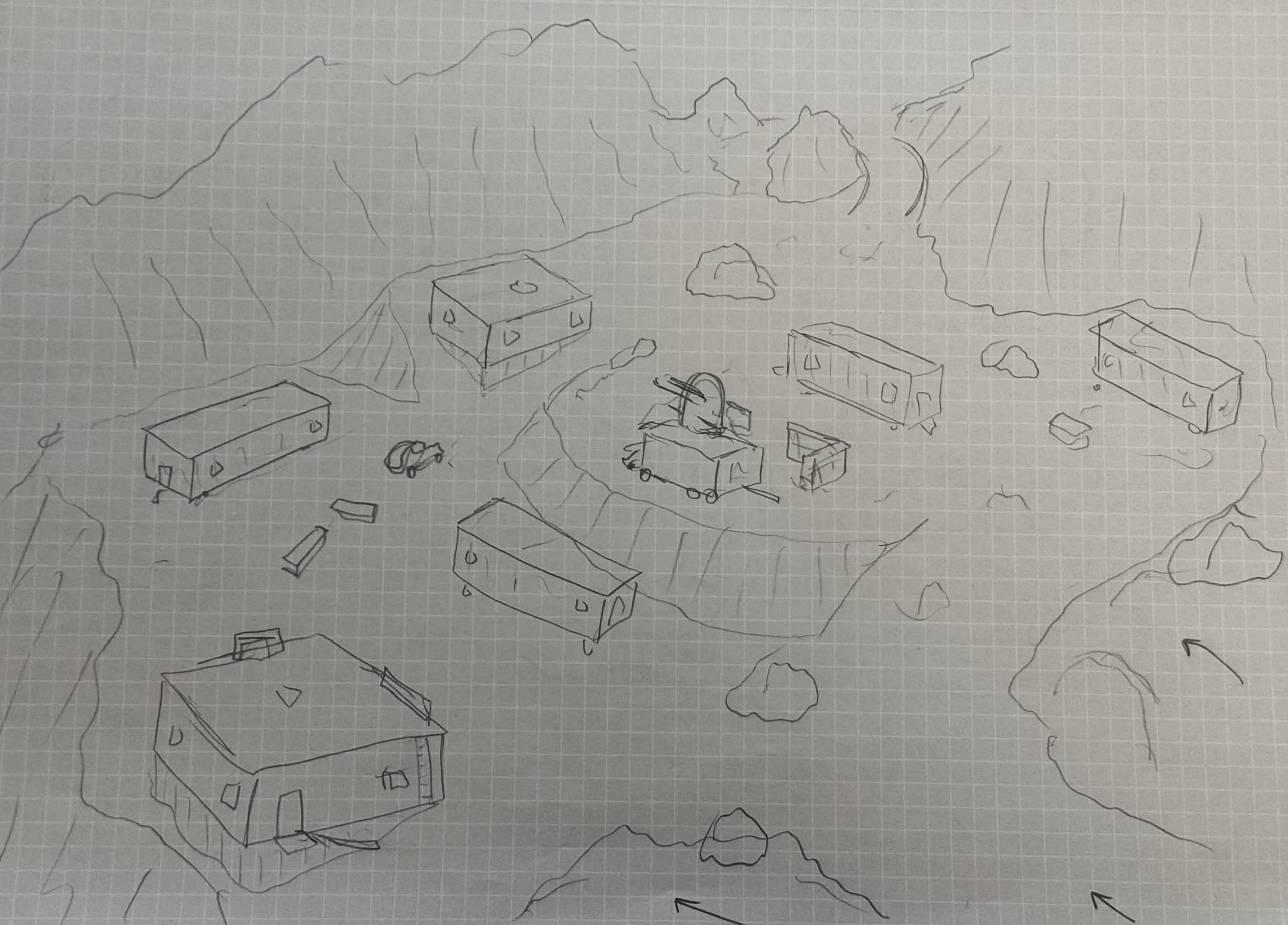
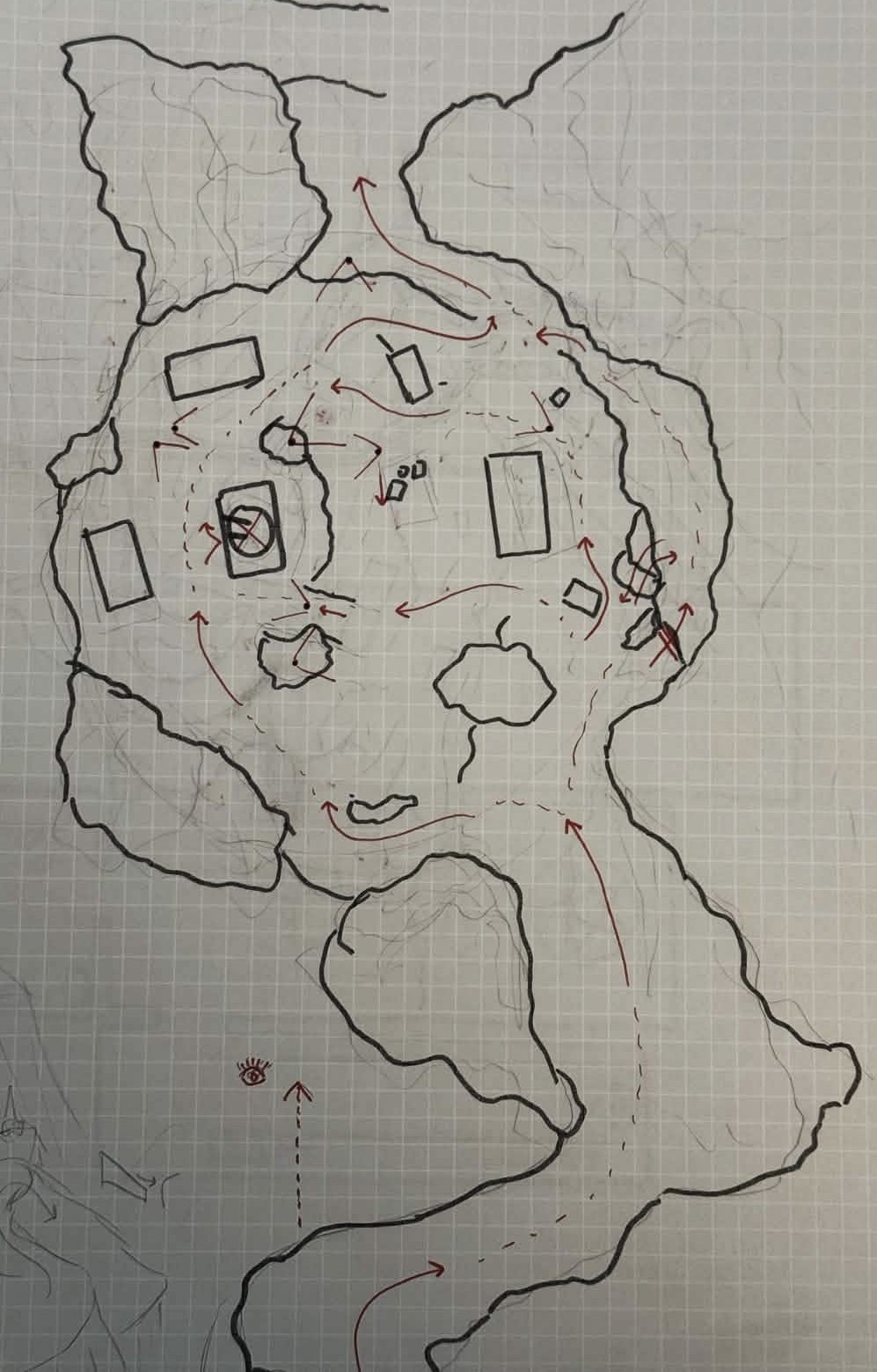
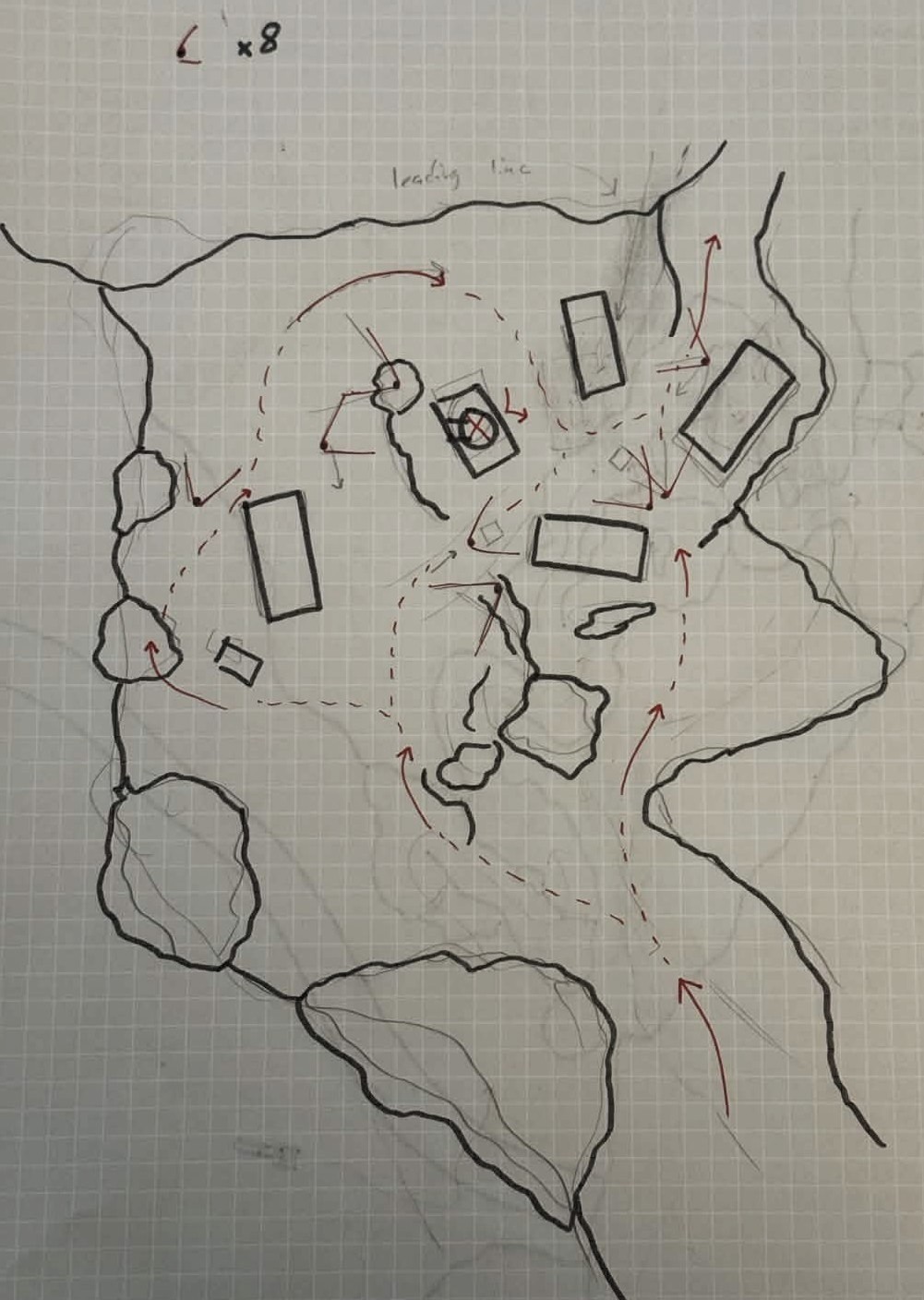
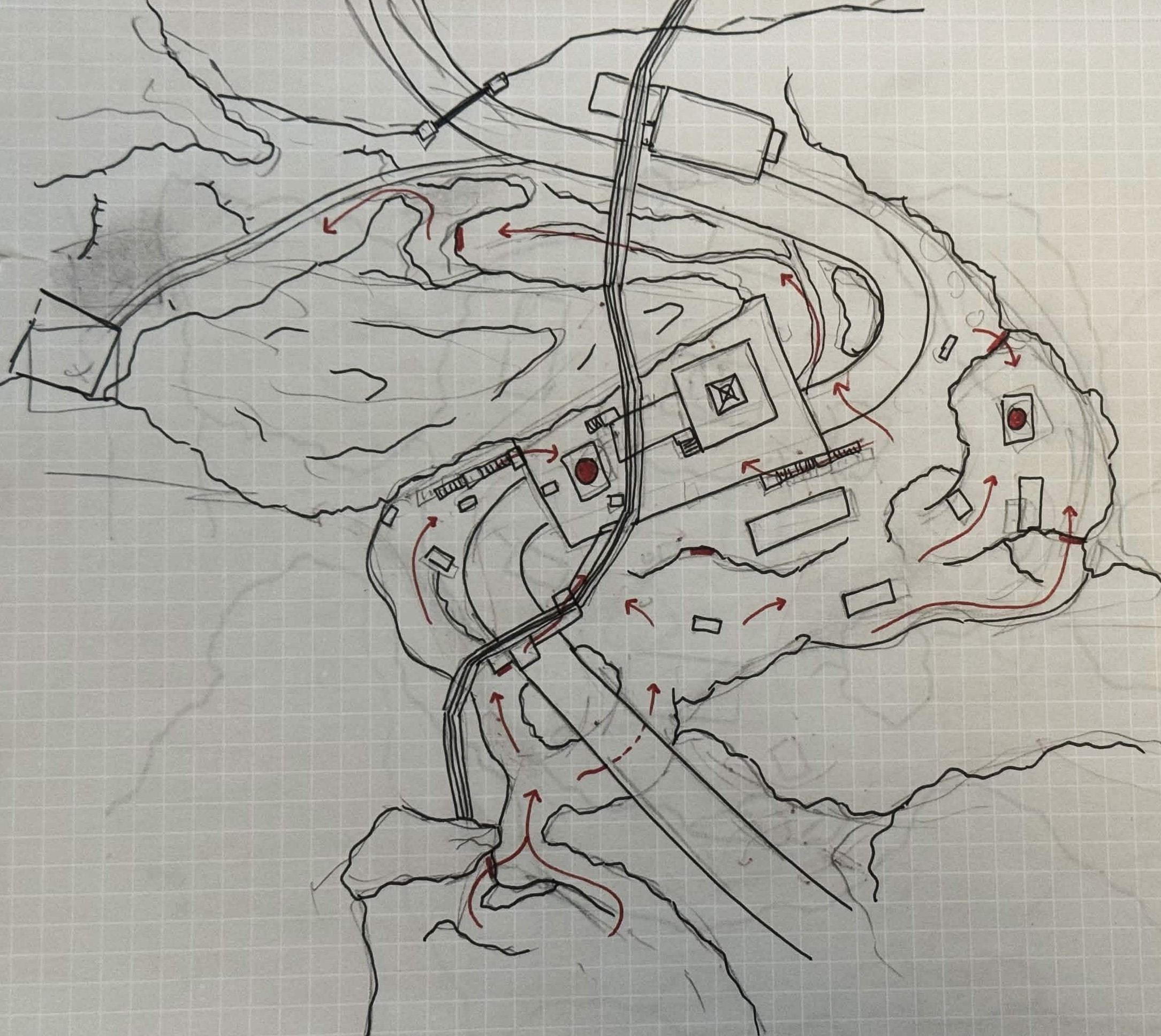
Brainstorming with a pencil in hand is my favorite part of the pre-production stage. I find it is a flexible and fast way for me to try out many different designs from a bird's view, and allows me to not commit to any specific design too early and getting caught up in details or having to spend time adjusting spatial relationships. Once I'm happy with an overall structure and flow, I start blocking out the scene in the Engine, but still always with my pencil still in hand. Even when I begin the blockout, which lets me see the space and distances between objects more clearly, I constantly switch back to my paper for further iterations.
Blockout
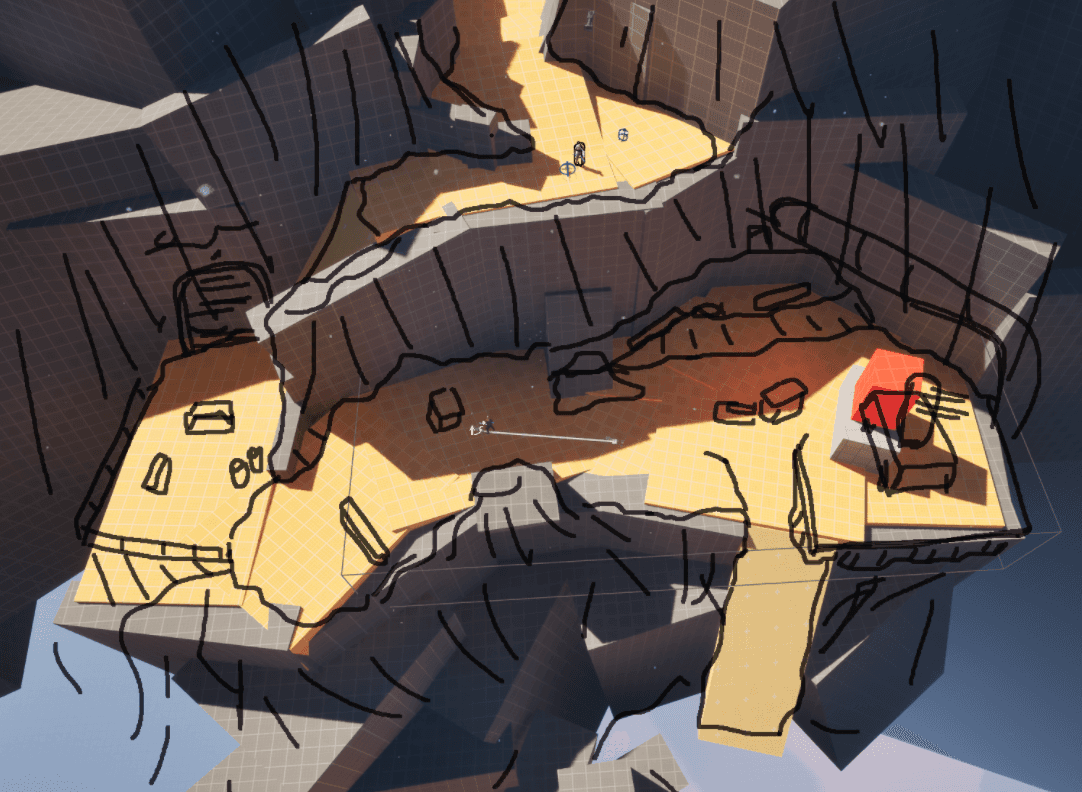
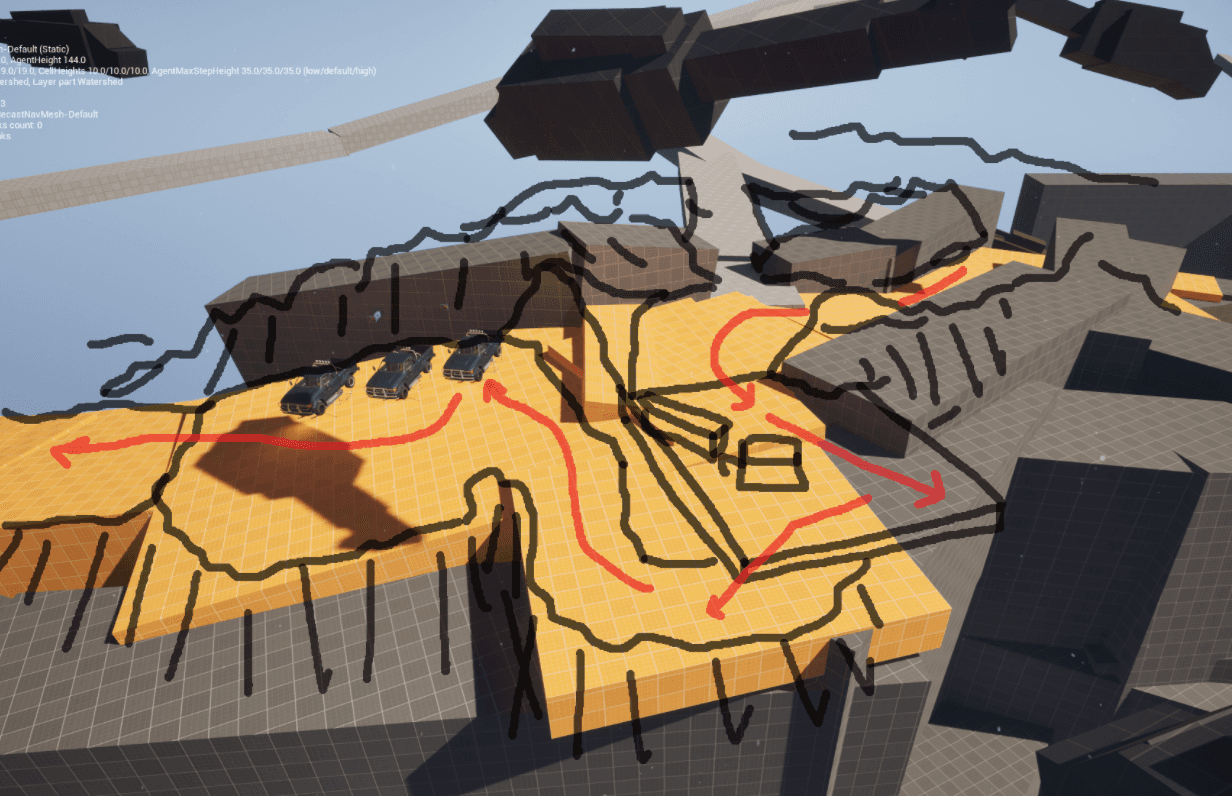
I keep the early stages of my blockout rough so that any changes can be done swiftly, and always try to focus on playability over any other polish. It also allows me to reach a Minimum Viable Product for the entire level early, accomplished by rapid testing and rough blocking of spaces. It is not until after this point, I start refining the blockout and leave my pencil to rest for the time being. When I start refining the rough blockout I first use a digital marker un top of my blockout, to better help me visualize the layout I am going for.


Narrative
Since narrative was a key focus for this experience, I developed it alongside the other core elements of the level, iterating and refining it over time. Midway through the project, I introduced the NPC "Pam", as I felt the player’s motivation and the overall story lacked some clarity and emotional weight. I beleive that this addition helped strengthen the narrative and provided a clearer sense of purpose for the player’s actions.
Pam's presence adds both context to the mission and adds emotional depth by sharing the risk through her parallel objective. She also serves as a consistent voice over the player's comms, throughout the level, reducing the sense of isolation and allowing for lighter, more personal moments.
Further, this connection makes the rendezvous at the radio mast feel more meaningful, making it both a gameplay objective and a place of brief safety. By ultimately having Pam killed, I create a sudden emotional shift in the experience, and hopefully deepen the player’s investment in the world I built.
Full Playthrough:
Full Playthrough:
Reflections:
My Goals & Intent
My primary design goal for this level was to build a world that felt whole and relatable. For this, I knew I needed to have the player feeling like their actions had an impact on the story and gameplay. I wanted to design the combat spaces in a way that could be played out in different approaches and give the player as much agency as I could with the time I had. I also wanted to create a world in which the player could get emotionally invested, whether that’s through their interactions with the NPC Pam, or the high stakes mission they find themselves in. My skills which I wanted to demonstrate with this piece, and practice on, were mainly World Building, Cinematics, and controlling a Tension Curve through pacing and level flow.
What I Learned
From this process, I learned a lot about player agency in PVE combat scenarios through both reading about them and analyzing existing levels in games I’ve come to love, like Far Cry 4 and Battlefield 4. Not only did I learn more about the practical things, but I also came to understand what really inspires me and how I love to express my own creativity through both epic cinematics and small details. And what surprised me most during development was probably my enjoyment of the Unreal Engine Sequencer tool. It was initially something I feared using coming into this project. From my time in the engine however, keyframing the movement of the helicopter, animating the NPC, or deciding when and where explosions go, I have not only learned an incredible amount about the Sequencer tool, but it has also been one of the most fun and rewarding experiences yet, and really let me live out my childish love of blowing stuff up (in-game of course…).
Today, based on what I have learned from this process, I would focus on the combat arenas more heavily from the get go. I was so caught up in making the world feel cohesive in the beginning and figuring out the whole narrative, that I left the combat arenas in the dark too long. I think this is shown in my blockout stage. And through playtesting, I didn’t iterate on the level design flow in my arenas as much as I had hoped, because of my time limit and time management. If I had put more focus on refining the actual combat arenas first, I would most likely have more fun and dynamic stealth sections and enemy encounters. Although in the end, I’m happy with the overall tension and length I achieved despite this.
Challenges & Solutions
The hardest problem I encountered when creating this experience was the visual readability. It was difficult because there were so many things to factor in, like enemies, points of interests, objectives, climbable walls, and dark surfaces. It was especially difficult in such a large environment with a constant shift in time of day. The level starts off in the night and ends just as the sun rises over the horizon. This meant that my techniques for combating bad lighting and readability varied depending on where in the level I was currently focusing. And having to jump back and forth, manually changing the time and weather in the editor, was not very intuitive. The ground was too dark and enemies blended into the environment and were difficult to see. Even the objectives (AA-guns) became one with thor surroundings.
As I didn't want any HUD elements, I had to work a lot with combating this with diegetic elements that made sense for the world I built, like large red lights above all AA-guns, military grade spotlights illuminating the path forward, or snow piles behind the enemy's silhouette to help them stand out better. I also amped up the fog to make the contrast between the immediate playable area and the sidescenes stronger. The trade-offs were not at all big and I think the level turned out much better overall.
What Worked Well
I believe that the opening act when the allied jets sweep in to attack, and is consequently shot at, achieved my goals for the scene successfully. I wanted to show a clear case of cause & effect, putting focus on the AA-guns being a problem needing to be dealt with.
I would also say that the final cutscene where the player gets their revenge on the helicopter indirectly, by allowing the allied forces back into the airspace safely, also achieved my goals well. I think the way I directed the cutscene gives the player a sense of fulfillment and satisfaction even more than had they blown up the helicopter themselves, implying that their earlier actions directly enabled this final victory. From the player perspective, I believe this to be the strongest moment of the experience.
If I Did It Again
If I had more time, I would refine the combat spaces and have them playtested more. While I’m happy with the layout I created, I think parts of it could be clearer for the player.
I would also have loved to have focused more on fun smaller gameplay mechanics that the player could utilize to feel smart and proud of themselves for discovering, like lootable and useful items in the small barracks, hidden routes leading to a better vantage point, or interactable objects allowing for more agency in their approach, ie. pushable crates or more ladders.
There are also a few things I would tweak. For example, the plume of smoke in the middle of the level caused by the downed jet is too large and bright, drawing attention to where it is ultimately not needed.
Lastly, it is also possible to progress through the first two AA-gun areas without actually planting the C4, hence breaking the game. I would fix this by having an environmental obstacle in the way of progressing further, which the player only wants to interact with after the bomb has been planted. It would, in the case of my level, work well if the main character explicitly says that he does not want to leave the area yet.
Closing Words
This is my most ambitious project yet, both in scope and the amount of design challenges I faced. Throughout the development, I focused on areas like tension, pacing, player guidance, and blending stealth combat with action cinematics. I’m very proud of this piece and forever happy that I’m able to express my creativity and ideas through this medium called video games.
I also want to thank my amazing classmates who have been such a tremendous help for me during this process, always happy to provide feedback and playtest. A big thanks to my educators Felype and Isak, whose insight and wisdom for Level Design and the industry have been invaluable to me.
Thank you for reading!!!
Level Breakdown:
Trailer:
Reflections:
Tension Graph:
Overview:
Section Walkthroughs and Stealth Combat:
The Snowmobile:
The descent introduces the snowmobile as a new traversal mechanic, giving the player a brief but engaging taste of high-speed movement. As the player rides down the mountainside, their companion splits off toward a parallel objective and joins them on the comms. I intentionally restrict the player by cutting the path short when another mountain stands in the way of the base, forcing the player to continue on foot and deliberately limiting their time with the vehicle. I establish the snowmobile as something valuable and exciting, and by introducing it early in a controlled way, I ensure that the player recognizes it in the final act, where its return should feel both natural and rewarding.
The Climb:
The radio mast and bunker are framed between peaks of the mountain, helping establish orientation and build a clear mental map. As the player ascends, these landmarks disappear from view, creating tension while still guiding movement in the correct direction. A rusted pipe lined with red lights leads the way upward, visually connecting to similar lighting around key objectives and reinforcing that the player is on the right path. The pacing slows in this section and I added an abandoned enemy camp to create unease and anticipation. At the summit, I funnel the player before revealing a wide vista, to heighten the impact of the enemy base reveal and reward the long climb.
Base Reveal:
The vista overlooks the enemy base, clearly revealing the AA-guns, bunker, and radio mast from a safe vantage point. This moment allows the player to study the layout and re-establish the radio mast as the rendezvous point. An enemy helicopter flies through the scene, naturally drawing attention to the AA-guns as it moves before disappearing behind a mountain peak. This encounter with the helicopter also acts as foreshadowing, setting up its later role in the final act.
First AA-gun:
In the first AA-gun area, the player slides down a slope into the encounter and is briefly exposed before reaching the safety of cover, creating a small moment of tension. After clearing the area, the player plants their first C4 charge. Entering the next area, a one-way valve prevents backtracking and helps maintain a clear mental map.
Second AA-gun:
The second area expands on player choice, offering more enemies and multiple paths. I iterated on cover placement to support different approaches to the objective and encourage experimentation. After planting the C4, the player ascends toward the next area where a tank is introduced as a new threat, briefly appearing and disappearing behind a rock before re-emerging as the player reaches the next space, increasing tension and anticipation.
Third & Fouth AA-gun:
In the third area, the tank remains an active presence, adding more pressure to the encounter. The player is tasked with planting C4 on two AA-guns. Increased enemy density and varied traversal options further reinforce player agency and maintains a hightened sense of danger.
Approaching the Radio Mast:
As the player exits, they must stealth past the tank while the helicopter reappears, guiding their attention toward the radio mast. This is followed by a sudden scare of the tank from an unexpected angle, reinforcing its threat. The player hides and continues forward, evading the helicopter by taking cover beneath a bridge. I use this part as another one-way valve which closes off previous areas, keeping focus ahead. The section ends with a tense stealth approach toward the radio mast, as the player navigates past both the tank and enemy soldiers.
The Radio Mast:
Upon reaching the radio mast, the perceived endpoint of the level, the player reunites with their companion and triggers the destruction of the AA-guns. The companion initiates the sequence with confident, almost cocky body language, reinforcing a shared sense of power and encouraging the player to feel equally impactful. This moment also provides a brief sense of safety, provided by the companion’s presence. That feeling is quickly disrupted as the helicopter returns, fulfilling its earlier foreshadowing and firing Chekov’s Gun. The companion directs the player toward a distant bridge as a new objective, but is killed in a shootout, shifting the emotional tone from confidence to urgency and loss.
First AA-gun:
The player enters the first stealth encounter from a covered position, giving them an advantage and control over when they feel ready to engage. This area introduces the core mechanics of stealth combat and planting C4 in a low-risk setting. Two nearby stationary enemies encourage the use of the silenced pistol or melee, while a second patrolling pair closer to the objective introduces movement between cover islands when approaching the enemies, and the use of the silenced sniper rifle since these enemies are farther away.
The Chase:
The player is immediately put into a high-intensity escape, jumping onto a snowmobile and racing down the mountain toward the bridge. This sequence pays off the earlier introduction of the vehicle, now fully realized in a fast-paced chase. I made the chase with lots of turns and constant pressure, leaving no room for rest and pushing tension to its peak. Halfway through the escape, the tank reappears and fires at the player, narrowly missing, again maintaining its presence as a persistent threat.
Process:
The Finale:
Still pursued by the helicopter, the player launches across a large gap, transitioning into a cutscene where they are thrown from the snowmobile and left injured and vulnerable. With no means to fight back, I’m hoping the player feels helpless as the helicopter closes in. Just before it fires, it is struck by a missile, creating a brief moment of confusion that quickly turns to relief as allied forces are revealed. A second strike destroys the helicopter, and friendly jets sweep into the valley, successfully bombing the bunker. The player regains a sense of safety, with the outcome showing that their earlier actions directly enabled this final victory.
Second AA-gun:
A vantage point allows the player to scout the next area with binoculars before engaging. The space has multiple paths and approaches, offering greater freedom in how to tackle the objective. Increased enemy presence, combined with a mix of patrols and stationed guards, raises the challenge. I use elements like enterable barracks, large rock formations, and smaller half-covers to create opportunities for unique and fun strategies.
Third & Fourth AA-gun:
The final two objectives take place within a single, more demanding area that tests the player’s accumulated skills. More stationary and patrolling enemies make navigation trickier, requiring good timing and awareness of most angles. A roaming tank adds pressure to this section, restricting some movement and acting as a natural boundary until both objectives are completed.
Brainstorming:
When I first started brainstorming ideas for this experience, I set up a few goals for myself. I wanted to make an Action Adventure level and have a main focus on Narrative and Story. I initially wanted the experience to be in First Person as many of my inspirations derived from campaigns of popular titles like Battlefield 4, Call of Duty and Far Cry 4. But eventually settled on Third Person like in the Tomb Raider series, because I felt such a perspective would allow me to really lean into the immersion and action, plus the over-the-shoulder camera allowed me more playroom when it came to cover placement and overall level design, especially in a stealth combat scenario, in comparason to the more narrow eye-centered First Person Perspective.
Setting up the location, I knew I wanted a cold, snowy, environment, and what better place of inspiration for that than in my own home country, Sweden? Which led me to the Arctic tundra region, particularly in the northernmost areas of Lapland.
Regarding combat design, I wanted to learn more about stealth combat and ways of making use of the environment as a playroom for the player, with lots of agency in how one chooses to approach one's objectives, whilst keeping the experience fairly linear in the grander picture.
I also wanted to make good use of Unreal Engine’s sequencer tool to really sell the action and cinematics with explosions and animations.
My ideas boiled down to this; The player sneaks into a snowy mountainous base and plants bombs on enemy Anti-Air guns in order to aid the allied forces. After a sudden twist, the player should need to improvise in order to escape.
Full Playthrough:
The Chase:
The path is designed with wide turns and some optional routes, including two risky jumps that make the fast-paced traversal feel dynamic and action packed.
Gathering References:
I used a Miro Board as a place for all my reference images and notes so that everything could be stored in the same place. Any location, concept art, architecture, and game inspiration was kept here. I let my references guide me through their shapes, layouts and spatial composition when making my first paper designs and blockouts. It really helped when envisioning what the areas would look like in the Engine.
Paper Design:
Brainstorming with a pencil in hand is my favorite part of the pre-production stage. I find it is a flexible and fast way for me to try out many different designs from a bird's view, and allows me to not commit to any specific design too early and getting caught up in details or having to spend time adjusting spatial relationships. Once I'm happy with an overall structure and flow, I start blocking out the scene in the Engine, but still always with my pencil still in hand. Even when I begin the blockout, which lets me see the space and distances between objects more clearly, I constantly switch back to my paper for further iterations.
Blockout:
I keep the early stages of my blockout rough so that any changes can be done swiftly, and always try to focus on playability over any other polish. It also allows me to reach a Minimum Viable Product for the entire level early, accomplished by rapid testing and rough blocking of spaces. It is not until after this point, I start refining the blockout and leave my pencil to rest for the time being. When I start refining the rough blockout I first use a digital marker un top of my blockout, to better help me visualize the layout I am going for.
My Goals & Intent
My primary design goal for this level was to build a world that felt whole and relatable. For this, I knew I needed to have the player feeling like their actions had an impact on the story and gameplay. I wanted to design the combat spaces in a way that could be played out in different approaches and give the player as much agency as I could with the time I had. I also wanted to create a world in which the player could get emotionally invested, whether that’s through their interactions with the NPC Pam, or the high stakes mission they find themselves in. My skills which I wanted to demonstrate with this piece, and practice on, were mainly World Building, Cinematics, and controlling a Tension Curve through pacing and level flow.
Reflections:
Narrative:
Since narrative was a key focus for this experience, I developed it alongside the other core elements of the level, iterating and refining it over time. Midway through the project, I introduced the NPC "Pam", as I felt the player’s motivation and the overall story lacked some clarity and emotional weight. I beleive that this addition helped strengthen the narrative and provided a clearer sense of purpose for the player’s actions.
Pam's presence adds both context to the mission and adds emotional depth by sharing the risk through her parallel objective. She also serves as a consistent voice over the player's comms, throughout the level, reducing the sense of isolation and allowing for lighter, more personal moments.
Further, this connection makes the rendezvous at the radio mast feel more meaningful, making it both a gameplay objective and a place of brief safety. By ultimately having Pam killed, I create a sudden emotional shift in the experience, and hopefully deepen the player’s investment in the world I built.
What I Learned
From this process, I learned a lot about player agency in PVE combat scenarios through both reading about them and analyzing existing levels in games I’ve come to love, like Far Cry 4 and Battlefield 4. Not only did I learn more about the practical things, but I also came to understand what really inspires me and how I love to express my own creativity through both epic cinematics and small details. And what surprised me most during development was probably my enjoyment of the Unreal Engine Sequencer tool. It was initially something I feared using coming into this project. From my time in the engine however, keyframing the movement of the helicopter, animating the NPC, or deciding when and where explosions go, I have not only learned an incredible amount about the Sequencer tool, but it has also been one of the most fun and rewarding experiences yet, and really let me live out my childish love of blowing stuff up (in-game of course…).
Today, based on what I have learned from this process, I would focus on the combat arenas more heavily from the get go. I was so caught up in making the world feel cohesive in the beginning and figuring out the whole narrative, that I left the combat arenas in the dark too long. I think this is shown in my blockout stage. And through playtesting, I didn’t iterate on the level design flow in my arenas as much as I had hoped, because of my time limit and time management. If I had put more focus on refining the actual combat arenas first, I would most likely have more fun and dynamic stealth sections and enemy encounters. Although in the end, I’m happy with the overall tension and length I achieved despite this.
Challenges & Solutions
The hardest problem I encountered when creating this experience was the visual readability. It was difficult because there were so many things to factor in, like enemies, Points of Interests, objectives, climbable walls, and dark surfaces. It was especially difficult in such a large environment with a constant shift in time of day. The level starts off in the night and ends just as the sun rises over the horizon. This meant that my techniques for combating bad lighting and readability varied depending on where in the level I was currently focusing. And having to jump back and forth, manually changing the time and weather in the editor, was not very intuitive. The ground was too dark and enemies blended into the environment and were difficult to see. Even the objectives (AA-guns) became one with thor surroundings.
As I didn't want any HUD elements, I had to work a lot with combating this with diegetic elements that made sense for the world I built, like large red lights above all AA-guns, military grade spotlights illuminating the path forward, or snow piles behind the enemy's silhouette to help them stand out better. I also amped up the fog to make the contrast between the immediate playable area and the sidescenes stronger. The trade-offs were not at all big and I think the level turned out much better overall.
What Worked Well
I believe that the opening act when the allied jets sweep in to attack, and is consequently shot at, achieved my goals for the scene successfully. I wanted to show a clear case of cause & effect, putting focus on the AA-guns being a problem needing to be dealt with.
I would also say that the final cutscene where the player gets their revenge on the helicopter indirectly, by allowing the allied forces back into the airspace safely, also achieved my goals well. I think the way I directed the cutscene gives the player a sense of fulfillment and satisfaction even more than had they blown up the helicopter themselves, implying that their earlier actions directly enabled this final victory. From the player perspective, I believe this to be the strongest moment of the experience.
If I Did It Again
If I had more time, I would refine the combat spaces and have them playtested more. While I’m happy with the layout I created, I think parts of it could be clearer for the player.
I would also have loved to have focused more on fun smaller gameplay mechanics that the player could utilize to feel smart and proud of themselves for discovering, like lootable and useful items in the small barracks, hidden routes leading to a better vantage point, or interactable objects allowing for more agency in their approach, ie. pushable crates or more ladders.
There are also a few things I would tweak. For example, the plume of smoke in the middle of the level caused by the downed jet is too large and bright, drawing attention to where it is ultimately not needed.
Lastly, it is also possible to progress through the first two AA-gun areas without actually planting the C4, hence breaking the game. I would fix this by having an environmental obstacle in the way of progressing further, which the player only wants to interact with after the bomb has been planted. It would, in the case of my level, work well if the main character explicitly says that he does not want to leave the area yet.
Closing Words
This is my most ambitious project yet, both in scope and the amount of design challenges I faced. Throughout the development, I focused on areas like tension, pacing, player guidance, and blending stealth combat with action cinematics. I’m very proud of this piece and forever happy that I’m able to express my creativity and ideas through this medium called video games.
I also want to thank my amazing classmates who have been such a tremendous help for me during this process, always happy to provide feedback and playtest. A big thanks to my educators Felype and Isak, whose insight and wisdom for Level Design and the industry have been invaluable to me.
Thank you for reading!!!